The dish I remember most from this trip to Thailand did not come from a starred restaurant. It came from a noodle shop inside a shopping mall.
We ate at plenty of expensive places that week — a Michelin-starred dining room, a colonial-house Thai restaurant, a rooftop bar thirty-two floors up. The plate I still think about is a pad thai at ICONSIAM.
- Into a mall that behaves like a market
- The shop with the teal shutters
- Soft noodles against crunchy sprouts
- This plate became the benchmark for the trip
- Practical notes
- More from this trip
- Pad thai at ros’niyom, ICONSIAM: questions I had
- Where is ros’niyom in Bangkok?
- How do I find the entrance?
- Do I need to speak Thai to order?
- What should I order?
- Why do the raw bean sprouts matter so much?
- Is the pad thai different from what I would get in Japan?
- What is there to drink?
- Do I need to book, and when is it quiet?
- How do I get to ICONSIAM?
- Is ICONSIAM itself worth the trip?
- How much does it cost?
- More from the same trip
Into a mall that behaves like a market
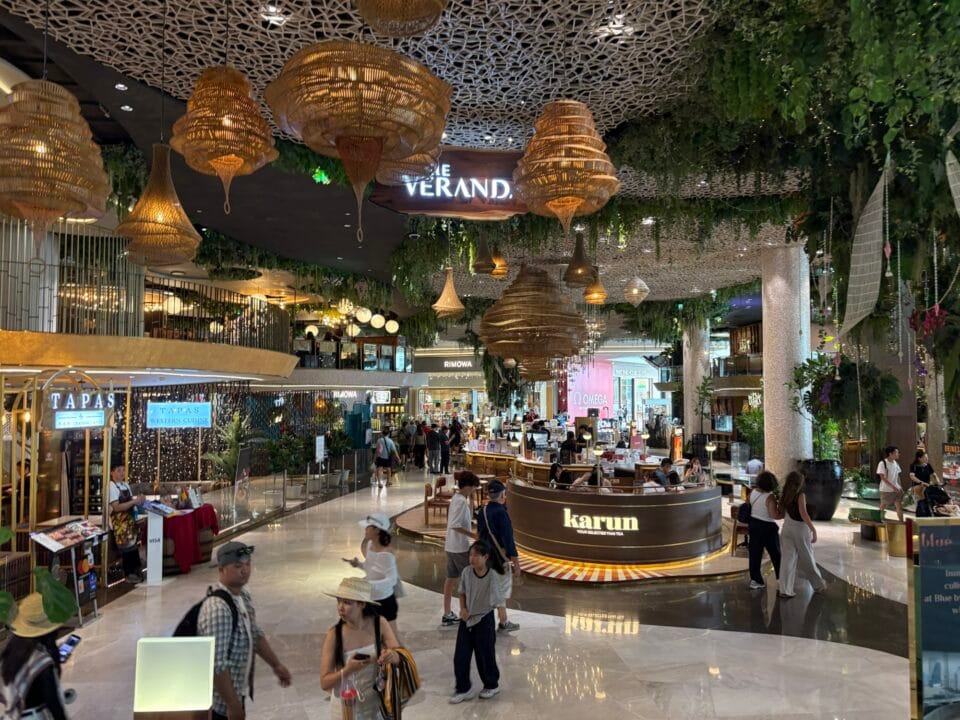
12:28. Inside ICONSIAM, on the Chao Phraya riverfront.
What is unusual about this building is that the interior does not read as a mall. Woven basket lampshades hang in clusters from a latticed ceiling, greenery spills down between them, and the shopfronts are arranged along what feels like a wide street rather than a corridor.

Look up and there is a canopy of woven lattice with plants trailing through it, and a heavy stone column rising into it. It is an indoor building doing a careful impression of an outdoor market.
That framing matters, because it primes you to eat like you would at a market rather than at a food court.
The shop with the teal shutters

12:43. We went into รสนิยม (ros’niyom) — the Thai word for taste, in the sense of what you happen to like.
The entrance is a teal-painted arch with louvred shutters, and a blue sign carrying the Thai script above the door. Inside, neon spells out Thai street food and Noodles. A host stands at a small wooden desk with a photo board of dishes propped beside it.

The menu is the kind that removes the language problem entirely: large photographs, one dish per panel. Boat-shaped plates of fried and grilled things, salads heaped with herbs, sausage with fresh vegetables. You can order by pointing.

12:45. Beer first: a chilled mug of draught, and bottles of Singha and Chang standing beside it on the wooden table. In that heat, at midday, this is simply the correct decision.
Soft noodles against crunchy sprouts
Then the pad thai arrived.
Here is the thing I had never registered before: what makes it work is not the noodles, it is the contrast.
Pad thai noodles are soft. Alongside them comes a pile of raw bean sprouts — cold, wet, and loudly crunchy. Every mouthful alternates between the two. Soft, then sharp. Soft, then sharp. The dish never flattens out, and you keep eating.
It is a dish built on texture, and I only understood that here. The pad thai I had eaten in Japan had never made the point so clearly — the sprouts are usually fewer, and often not raw enough to matter.
If you take one thing from this: do not push the bean sprouts to the side of the plate. They are not garnish. They are half the dish.
This plate became the benchmark for the trip

13:10, back outside. A golden sculptural arch stands in the plaza, twin towers rising behind it, under the flat grey of a humid Bangkok afternoon.
We went on to eat at considerably more expensive places that week. And yet, back home, the meal that kept surfacing was this one, in a mall, for the price of lunch.
How much a meal costs and how long it stays with you are not the same axis. That was the real souvenir from this trip.
Practical notes
- Visited: 22 August 2025, around 12:30–13:10.
- Restaurant: รสนิยม (ros’niyom), inside ICONSIAM, Bangkok. Look for the teal arched entrance with louvred shutters; the neon inside reads “Thai street food / Noodles”.
- Ordering: the menu is photo-led and easy to order from by pointing. No Thai needed.
- What to get: pad thai. Eat it together with the raw bean sprouts — the soft-versus-crunchy contrast is the whole point.
- Drinks: draught beer, plus Singha and Chang by the bottle.
- Timing: we walked in around 12:30 on a weekday without waiting.
- Getting there: ICONSIAM sits on the Chao Phraya. Arriving by river boat is more enjoyable than arriving by road.
- Note: menus, prices and opening hours change — check locally before you go.
Visited August 2025. Details are as of that visit.
More from this trip
- The other side of the same trip: the Longevity Hub at The St. Regis Bangkok
- What I walked around in: Hermès Izmir sandals, one year on
- Out for dinner with one card: the Hermès MagSafe card case
- Another Asian city seen from the water: Marina Bay Sands from across the bay
📖 A Private Wisdom guide to Japan
Don’t Do That in Japan — a local’s guide to etiquette, trains, convenience stores, onsen, and traveling Japan with confidence. Free to read with Kindle Unlimited.
▶ Read on Amazon (Kindle Unlimited)Pad thai at ros’niyom, ICONSIAM: questions I had
Where is ros’niyom in Bangkok?
It is inside ICONSIAM, the mall on the Chao Phraya riverfront. We walked in at 12:43 on a weekday. Floor plans and tenants change, so check the mall directory when you arrive.
How do I find the entrance?
Look for a teal-painted arch with louvred shutters and a blue sign carrying Thai script above the door. Inside, neon spells out “Thai street food” and “Noodles”, and a host stands at a small wooden desk with a photo board of dishes propped beside it.
Do I need to speak Thai to order?
No. The menu removes the language problem entirely: large photographs, one dish per panel — boat-shaped plates of fried and grilled things, salads heaped with herbs, sausage with fresh vegetables. You can order by pointing.
What should I order?
The pad thai. That is the plate I still think about, ahead of the starred restaurant and the colonial-house Thai restaurant we ate at the same week.
Why do the raw bean sprouts matter so much?
Because the dish is built on contrast, not on the noodles. Pad thai noodles are soft; the sprouts that come alongside are cold, wet and loudly crunchy. Every mouthful alternates — soft, then sharp — so the dish never flattens out. Do not push the sprouts to the side of the plate. They are not garnish; they are half the dish.
Is the pad thai different from what I would get in Japan?
In my experience yes, and the difference is the sprouts. The versions I had eaten in Japan came with fewer sprouts, often not raw enough to make the textural point.
What is there to drink?
Draught beer by the chilled mug, plus Singha and Chang by the bottle. At midday in that heat, beer first is simply the correct decision.
Do I need to book, and when is it quiet?
We walked in around 12:30 on a weekday without waiting. I did not book.
How do I get to ICONSIAM?
It sits on the Chao Phraya, so arriving by river boat is more enjoyable than arriving by road.
Is ICONSIAM itself worth the trip?
The interior does not read as a mall. Woven basket lampshades hang in clusters from a latticed ceiling, greenery spills down between them, and the shopfronts run along what feels like a wide street rather than a corridor — an indoor building doing a careful impression of an outdoor market. Outside, a golden sculptural arch stands in the plaza with the twin towers rising behind it.
How much does it cost?
I am not quoting a figure, because menus, prices and opening hours change. Check the current menu locally before you go — the point of the meal was that it cost the price of lunch and still outlasted the expensive places.
More from the same trip
Related Articles
- [Yokohama] Breakfast at Le Normandie, Hotel New Grand: A Monte Cristo With the Harbor in View
- Three Meals in Yokohama: Octopus at Del Mar, a Burger at Larboard, Teppanyaki at Sagami
- [Yokohama] The Elevator Doors Open onto Seoul: A Revenge Reservation at Korean Restaurant Kimuchacha
- A sharing menu at IGNIV Bangkok, and a star I could not quite taste


Comments