On the Shinko pier in Yokohama stands a hotel whose rooms all face the sea: InterContinental Yokohama Pier 8. I have stayed here several times, and I like the slow hour of drinking coffee while watching the morning harbour. But there is one place inside this hotel that I do not visit often. On the third floor is the sushi counter Katabami, and I keep it for occasions that deserve it.
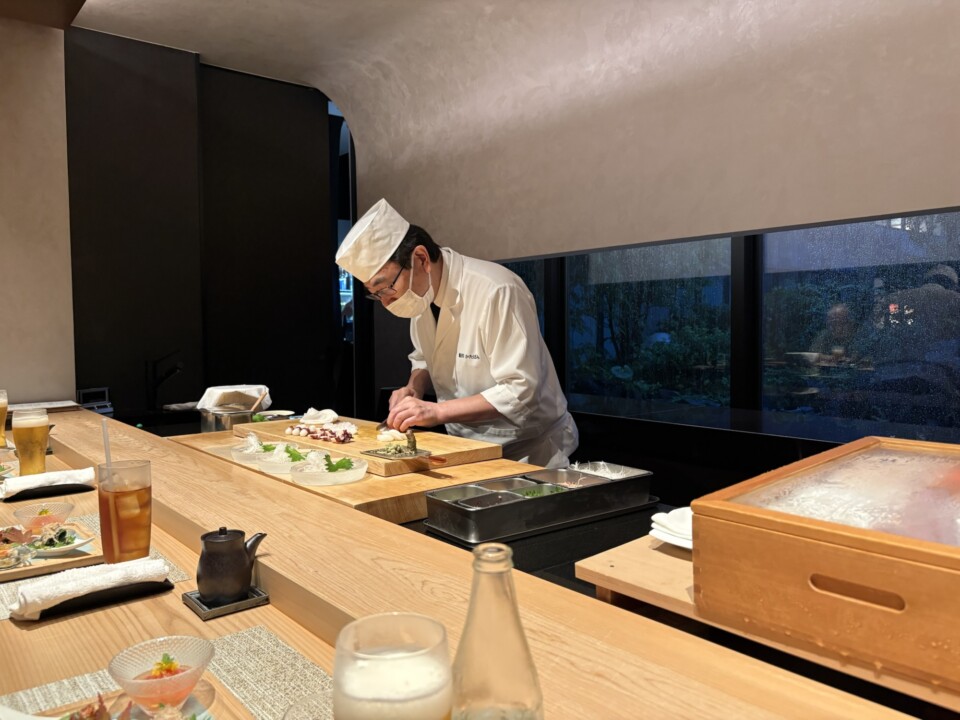
The restaurant faces the hotel courtyard, and the counter seats only nine. After dark, the planting beyond the glass sinks into black, and your own reflection floats faintly in front of it. The noise of the hotel feels far away. It may be the quietest room in a hotel built out on a pier.
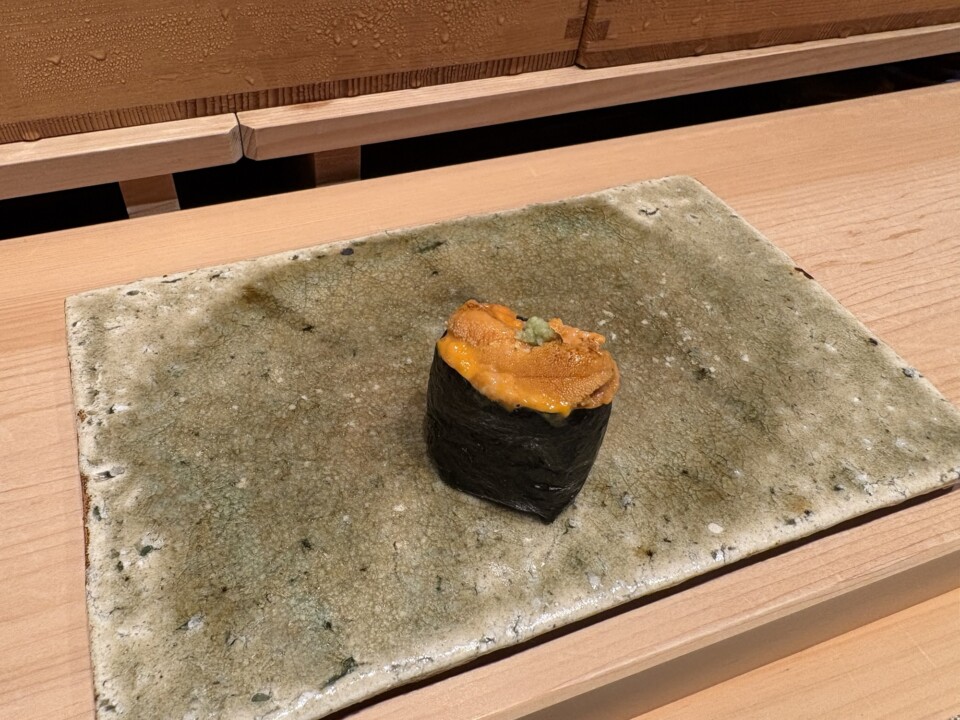
Sea urchin, salmon roe, and the nori
The fish is prepared right in front of you. On a small board set on the pale wooden counter, the knife goes in, a brush moves, the rice is pressed, and the piece is set down without a word. At this distance you are eating the gestures as much as the food.
The sea urchin and the salmon roe were, as expected, in another class — a sweetness that unravels on the tongue, with the scent of the sea rising a beat later. What stayed with me most, though, was the nori. The moment it entered my mouth the aroma of the shore opened up. I had not thought the seaweed on a gunkan could be the lead role.
I learned afterwards that the nori comes from Tsutakin Shoten, a seaweed wholesaler in Yokohama’s Kanagawa Ward that has been trading since 1894, and is known locally as the family business of the comedian Tetsuro Degawa. Sushi from the harbour, wrapped in nori that has been sold in the same city for more than a century. Less a story about provenance than a story about the town itself.
That evening they also prepared raw octopus for my daughter. Uncooked, it grows sweeter the longer you chew. She was delighted, and eyed our portions as well. A restaurant that remembers what a child likes becomes, for that reason alone, a special restaurant.
Five of Kanagawa’s fourteen breweries, on one tray
The other pleasure of the night was a tasting flight of local sake. Six of them. Small glasses arranged on wooden trays, each with a card in front naming the brewery.
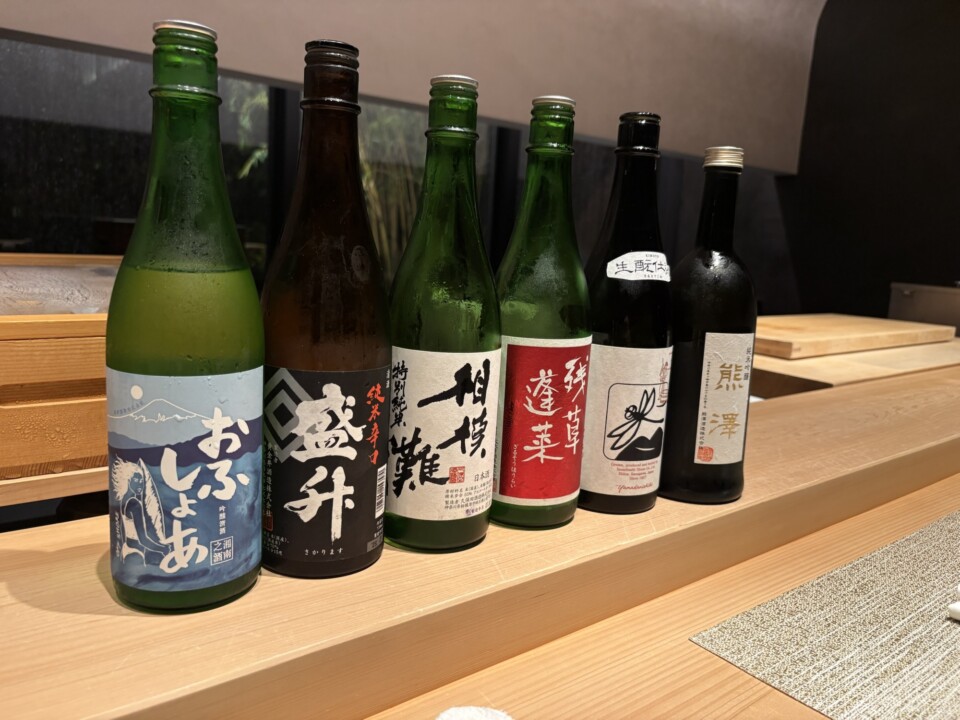
Sagaminada, Morimasu, Offshore, Zaruso Horai, Izumibashi, Kumazawa. Looking at the names, I noticed something: they were all from Kanagawa. Sagaminada from Kubota Shuzo in Sagamihara, Morimasu from Koganei Shuzo in Atsugi, Zaruso Horai from Oyataka Shuzo in Aikawa, Izumibashi from Izumibashi Shuzo in Ebina, and Kumazawa Shuzo in Chigasaki. Kanagawa has fourteen sake breweries in all, which means five of them were sitting on a single tray.
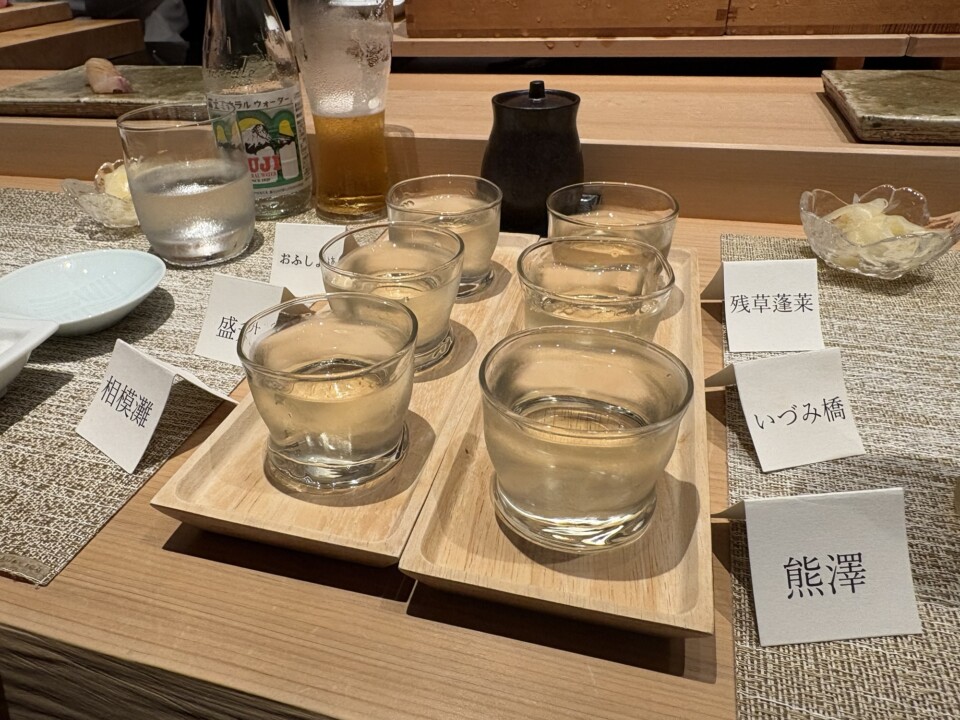
Drinking through them, you realise how wide the range is even within one prefecture: one clean and dry, one where the sweetness of the rice comes forward, one with a bright line of acidity. The same Kanagawa water and rice, and yet this much difference. We drank them alongside the sushi, rearranging the little cards as we went.
When I eat in Yokohama I tend to look for a seat with a view of the water. But an evening like this one — facing the dark of a courtyard, nine seats, eyes on nothing but a pair of hands — is not worse. What makes an occasion special is probably not the grandeur of the place, but exactly that kind of quiet.
Katabami: Frequently Asked Questions
Where is Katabami?
It is on the third floor of InterContinental Yokohama Pier 8, on the Shinko pier in Yokohama. The counter faces the hotel courtyard, and after dark the planting beyond the glass sinks into black with your own reflection floating faintly in front of it. It may be the quietest room in a hotel built out on a pier.
How many seats does it have?
The counter seats only nine. Because the room is that small, please check the hotel’s official site for the latest on reservations and opening hours.
How many local sakes are in the tasting flight?
On my visit it was six, served as small glasses on a wooden tray with a name card for each brewery in front: Sagaminada (Kubota Shuzo, Sagamihara), Morimasu (Koganei Shuzo, Atsugi), Offshore, Zaresou Horai (Oyataka Shuzo, Aikawa), Izumibashi (Izumibashi Shuzo, Ebina) and Kumazawa (Kumazawa Shuzo, Chigasaki). Kanagawa has fourteen sake breweries, so five of them were sitting on that one tray. The line-up changes with the season.
What stayed with me most?
The sea urchin and the salmon roe — and, unexpectedly, the nori. The moment it went into my mouth the scent of the shore opened up, and I found myself wondering whether the seaweed on a gunkan could really be the lead. I was told it comes from Tsutakin Shoten in Kanagawa Ward, Yokohama, a nori wholesaler founded in 1894 and still going after more than 130 years. A harbour sushi counter, and seaweed traded in the same city for over a century.
Is it suitable for children?
They prepared raw octopus for my daughter that evening. Uncooked octopus grows sweeter the more you chew it, and she was delighted — eyeing our portions as well. Whether that is possible depends on the day, so it is best to ask when you book.
More from Yokohama
- Three Hours in Yokohama Hotels
- Breakfast at Le Normandie, Hotel New Grand
- Sunday brunch-hopping at BASEGATE Yokohama Kannai
- The Westin Yokohama club lounge: the steak was the thing
Visited in August 2026. Prices and opening information are as of the time of the visit.
📖 A companion guide from Private Wisdom
Eating your way around Japan? How to Eat in Japan — a long-time local’s friendly guide to ordering, dining etiquette, and what to actually eat, from the convenience store to the sushi counter. Free to read with Kindle Unlimited.
▶ Read on Amazon (Kindle Unlimited)Related Articles
- [Yokohama] A Kyoto Breakfast at Hotel New Grand: Rice or Porridge on the Fifth Floor
- [Toyosu] Eleven O’Clock Is the Answer at Senkyakubanrai: Maruri Suisan’s Uni Bowl and the Spend That Makes Parking Free
- Korokke from Hayama Asahiya: thirteen minutes and a Sunday queue
- [Busan] BIFF Square to Bupyeong Kkangtong Market: An Evening of Street-Stall Hopping in Nampo-dong
Comments