Walk through Seoul for a single afternoon and one name keeps intercepting your line of sight: Compose Coffee. The density is the astonishing part. Turn a corner, there is another one; turn again, another. “Everywhere” is not an exaggeration here — it is the store-opening strategy, stated plainly in architecture.
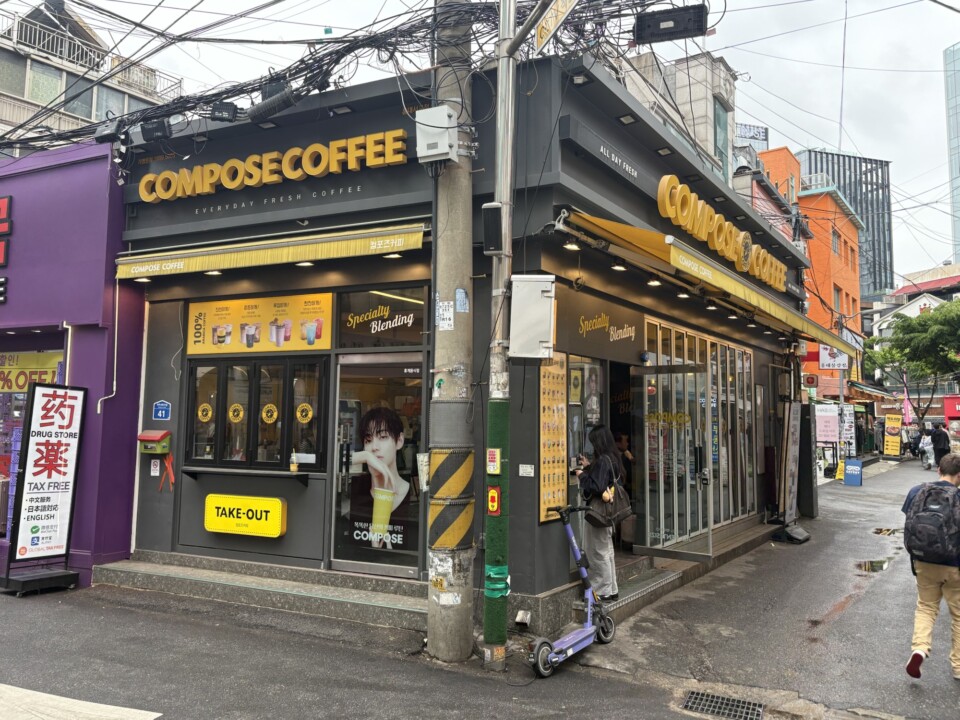
The promotion operates at the same scale. Building-top billboards the size of tennis courts carry the gentle gaze of BTS’s V across entire intersections. Try to name a Japanese café company that hires a star of that magnitude and repaints a city’s skyline with him. I could not.
A café economy running at a different voltage
In Korea, the café long ago stopped being a place that merely serves drinks; it is a full economic zone. Promotion on this scale speaks to the ferocity of the competition, and beyond that, to the cultural weight the café format carries here. Looking at it through a merchant’s eyes, this kind of capital deployment only makes sense on top of a powerful brand strategy and a rate of everyday consumption that would exhaust most markets. Japanese cities have dense café coverage too — but a chain that dominates the visual landscape itself is rare. In Seoul, café culture has effectively become urban infrastructure, and that is something you only really absorb by walking the streets.
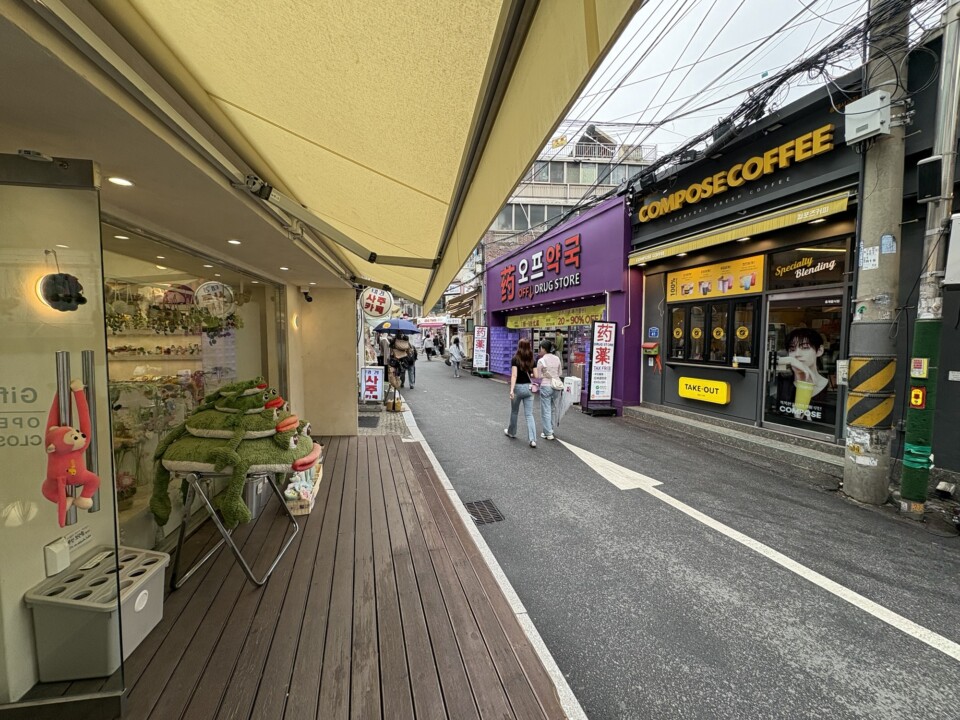
What to order at Compose Coffee
Prices sit around 2,000–3,000 won a cup — roughly 200–225 yen — which puts Compose at the very top of Seoul’s value rankings. The signature latte and the soft egg sandwich are the safe, satisfying picks. The coffee itself is engineered for daily reliability rather than occasion: not a tourist’s café but the kind locals run on every morning, and that concept holds consistent through the pricing and the spaces alike.
What a traveler learns from an ordinary cup
Every visit to Seoul, the speed and scale of its consumer culture startles me all over again, and Compose Coffee is one of its cleanest symbols. Ordering “the normal thing” in a foreign city — not the famous thing — is often the fastest way to read how a society actually lives. A 2,000-won latte turned out to be a better economics lesson than most museums.
Related Articles
- The St. Regis Osaka: The Ultimate Luxury Stay in Honmachi (Osaka Expo Access)
- Excellent Minari Komtang at Noondong Minari in Seoul Sungsui! Healing Lunch Experience
- St. Regis Bangkok Pool: An Outdoor Oasis Above the City Skyline
- Shizuoka's Hidden Hot Spring Resort: An Exquisite Healing Journey in Shuzenji
Comments