The crane and long-tailed tit photographs in this article have dark circular corners. That is because they were taken by holding a phone against the eyepiece of a spotting scope.
Which is more or less the whole truth about photographing birds in eastern Hokkaido in winter. It matters far less what camera you brought than whether you are somewhere with a scope you can look through.
Lake Kussharo was frozen only at the edges

Lake Kussharo, in the town of Teshikaga, is Japan’s largest caldera lake, inside Akan-Mashu National Park. Average depth 28.4 metres.
By February it freezes over completely, and omiwatari appears — saddle-shaped ridges where the ice pushes against itself, here on a scale of 5 to 10 kilometres, among the largest in Japan. On this visit, though, only the edges had frozen, as the photograph shows. Ice depends on the year and the timing.
Hot springs rise around the shore, which keeps patches open all winter. Those are the corners where whooper swans gather.
You watch the cranes through a scope
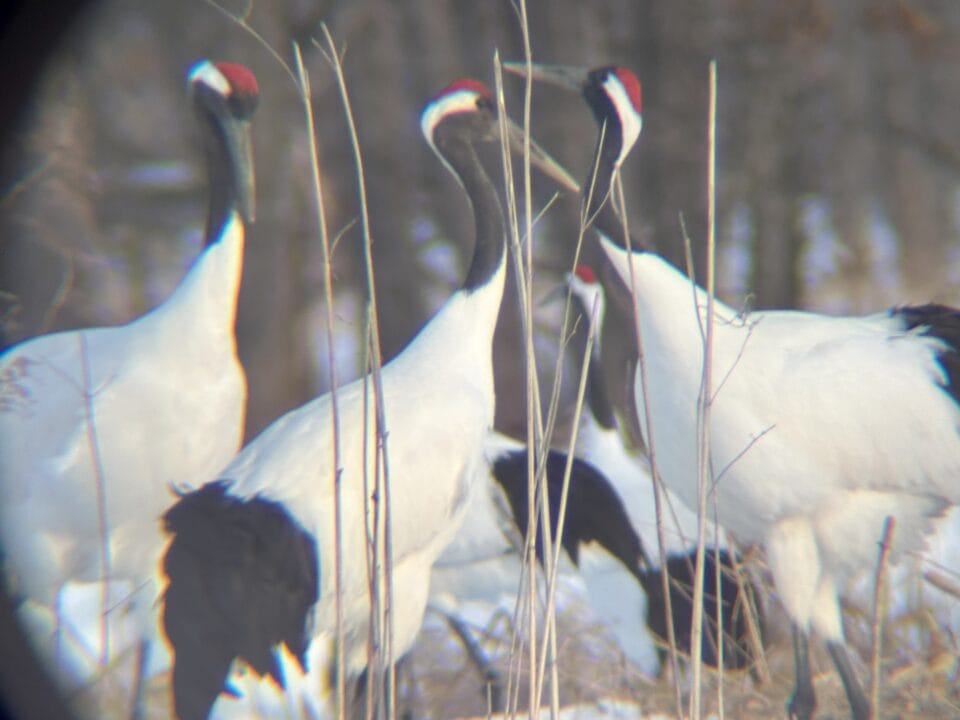
Four red-crowned cranes, the red crown and the black-and-white plumage clearly legible.
But this is not what your eyes see, nor what an ordinary telephoto gives you — it is the view down a spotting scope. The rounded, darkened corners are the giveaway. The guide sets up the scope, everyone takes a turn, and you hold your phone to the eyepiece. That produced the only photographs where the birds actually read.
Do not feed them and do not close the distance — that goes without saying. Precisely because you cannot get closer, you borrow the optics.
Don’t hunt for the long-tailed tit. Wait at the feeder
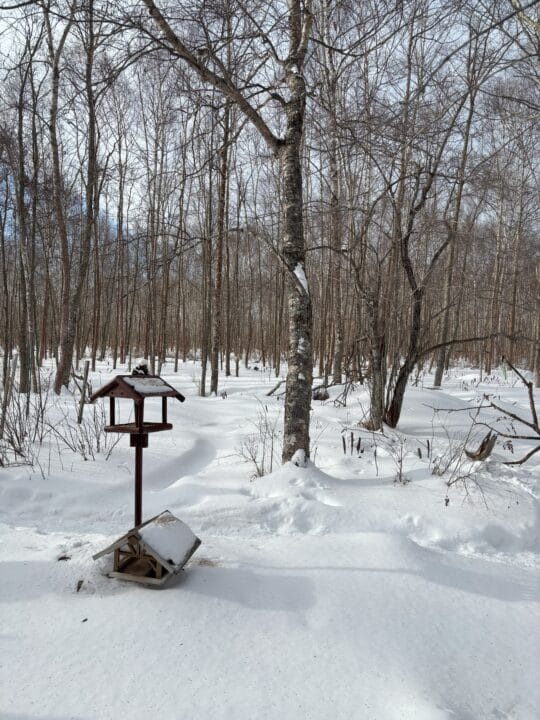
This may be the most useful photograph here: a roofed wooden feeder standing in the snow among birches.
Shima-enaga move through the woods fast, so walking around looking for them is inefficient. Waiting at a feeder is far more reliable. The footprints around it belong to people who worked that out before us.
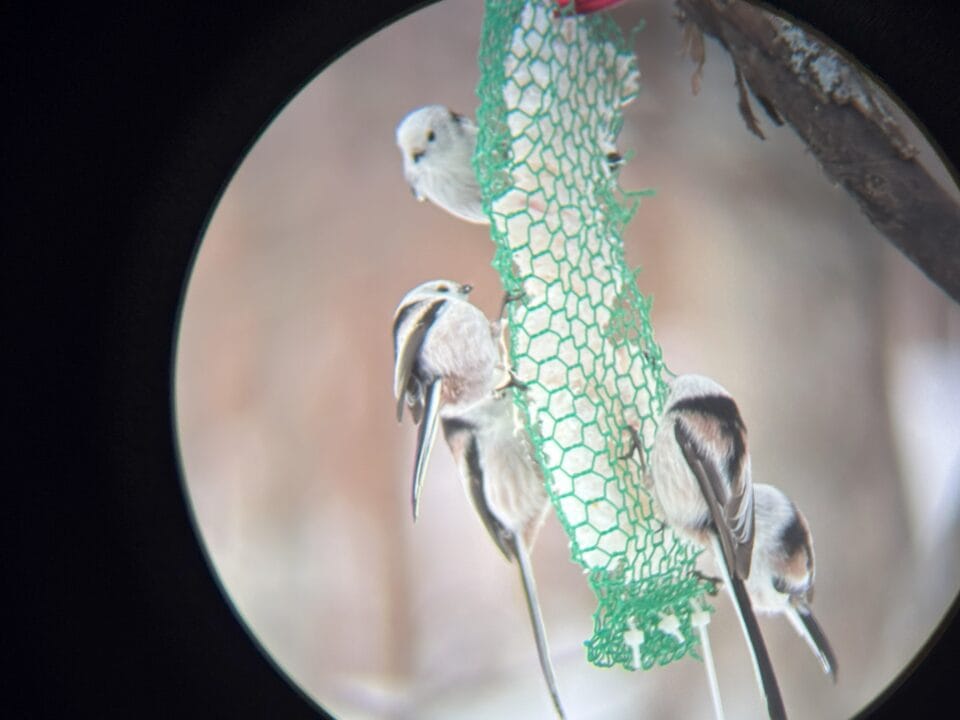
And there it is, clinging to a green mesh feeder of suet. Rounded corners again — scope again.
- Shima-enaga is the Hokkaido subspecies of the long-tailed tit
- 14 cm long — smaller than a sparrow, and a good part of that is tail
- In winter it travels with mixed flocks of tits, so look for it inside a moving group rather than alone
- It feeds hanging from the tips of branches, so it never stays in one place
It gets called “the snow fairy”. In person it is startlingly small and startlingly restless. You do not compose a shot so much as press the button the instant it lands.
The weather takes everything
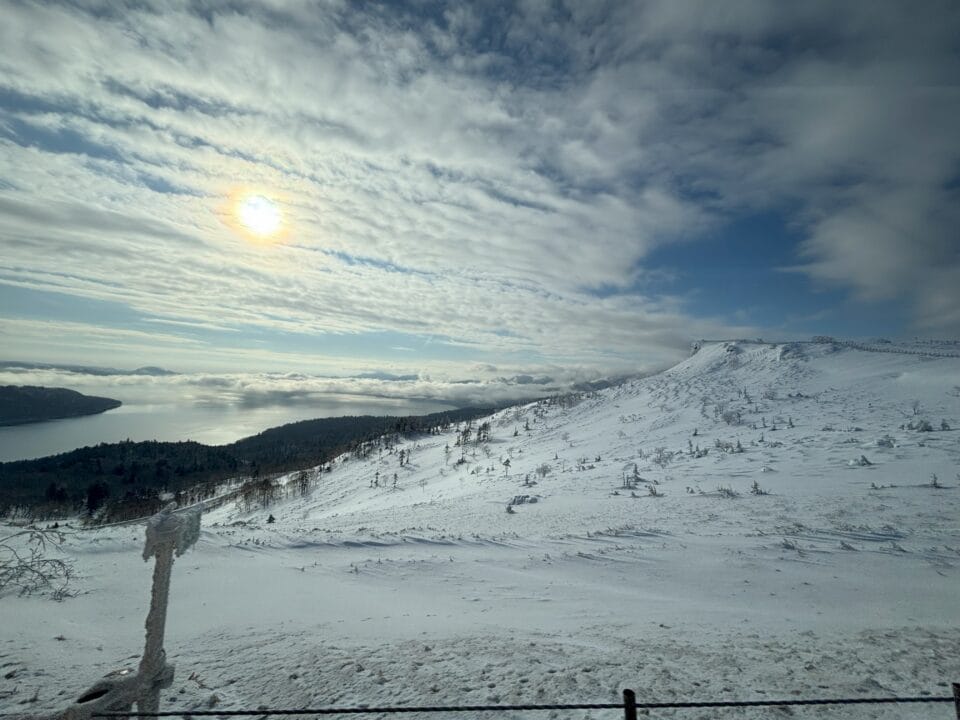
Winter here is either clear, with light arriving straight and hard, or overcast and dim all day. Bird photographs are entirely a question of light, so the weather decides your results.
Leave slack in the itinerary if you can. Bet everything on one day and a single grey morning ends the trip’s photography.
What actually earned its place in the bag
- Access to a scope — a guided tour is the simplest way to get it
- A phone — held to the eyepiece; a proper adapter is better still
- Spare batteries or a power bank — below freezing they drain fast. Keep them in an inside pocket
- Cold-weather kit — waterproof boots, heavy coat, gloves, hat, neck warmer. Some tours rent it
- Binoculars — if you are only looking and not shooting, these are the most fun of all
Summary
- Both cranes and shima-enaga are realistically seen through a scope — the round corners in these photos are the evidence
- Access to a scope matters more than the camera you own
- Wait at a feeder rather than hunting through the woods
- Shima-enaga is 14 cm, smaller than a sparrow, and never still
- Lake Kussharo is Japan’s largest caldera lake; February brings full freezing and omiwatari, but the ice depends on the year
- Weather decides the outcome, so build slack into the dates
If you are doing an eastern Hokkaido winter, this one goes with it: The Notsuke Ice Horizon Is Not Something You Just Turn Up For.
📖 A companion guide from Private Wisdom
Visiting in the cold season? Japan in Winter — snow country, hot springs, drift ice and what to pack, from a long-time local. Free to read with Kindle Unlimited.
▶ Read on Amazon (Kindle Unlimited)
Comments