I saw the Buddha head swallowed by tree roots. My first thought was: smaller than I expected.
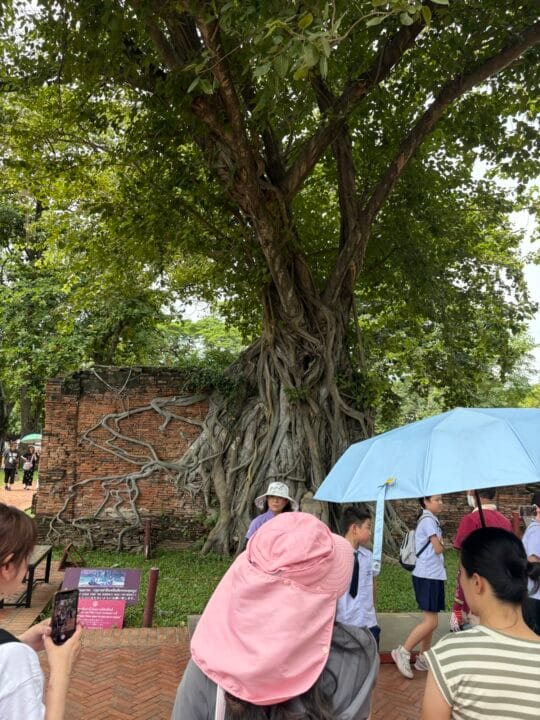
There is one tree people are gathered under
A little after eleven in the morning we went into Wat Phra Mahathat. Walking the grounds, there is one spot — under a single tree — where everyone is standing. Parasols in a row, people waiting their turn. That’s it, obviously.
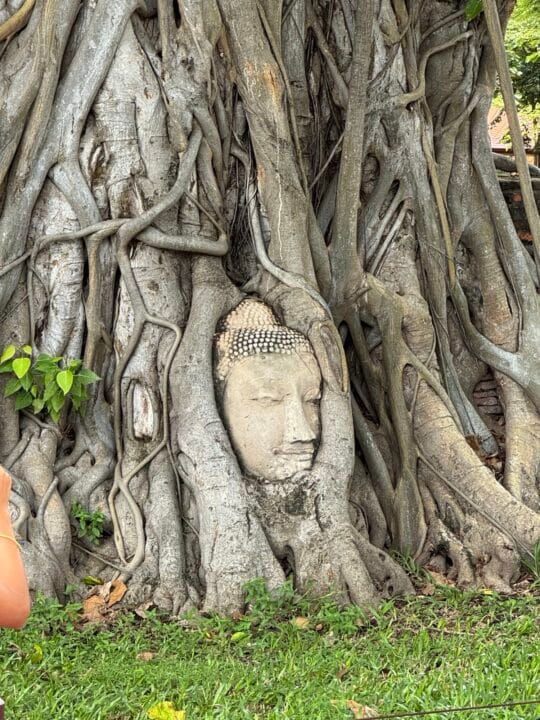
Smaller than I had pictured
Getting close, the first thing I registered was the size. From photographs I had imagined something much larger. In fact it is not far off the size of a person’s head. It fits neatly into the gap between the roots.
Which cuts the other way, in the end. This is not a colossal relic; it is something you could carry in your hands, and it has been absorbed by a tree and arrived here.
One practical thing, and it matters: you are expected to get your own head lower than the Buddha’s. Photographs are taken from a kneeling or crouching position, not standing, and a guard enforces it — a whistle if you stand too tall or press too close. Knowing that before you join the queue saves you the correction.
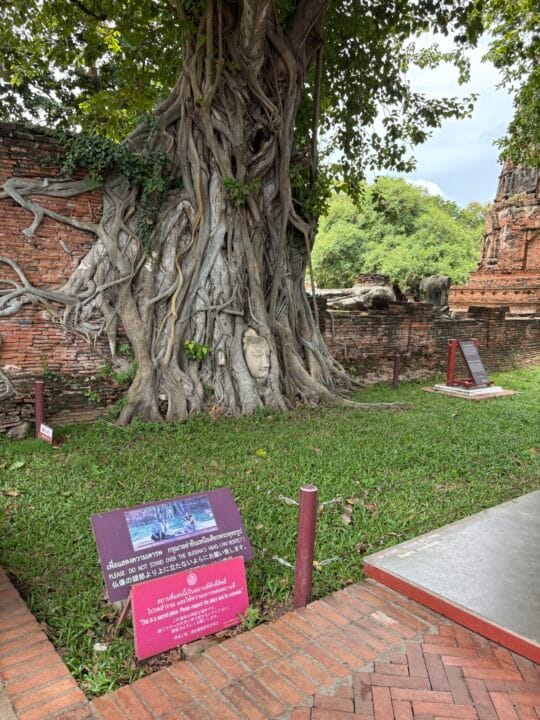
There is more than one account of how it got there
Why the head is there is not settled.
What I was told was that someone trying to steal it could not carry it, left it, and the tree grew up and took it in. The Tourism Authority of Thailand’s account is that the head is said to have fallen at the foot of the tree during the war that ended Ayutthaya. Both are written as things that are related, not established. A commonly cited version splits the difference on timing: either the tree simply grew around it during the centuries the temple lay abandoned, or a treasure-hunter moved it and abandoned it in the early twentieth century.
What every version has in common, though, is that nobody set it here on purpose. It fell, or it was left. After that it was the tree’s work, a few hundred years of roots closing around it.
People broke this place, and something other than people has spent a long time giving it another form. That was the part that stayed with me.
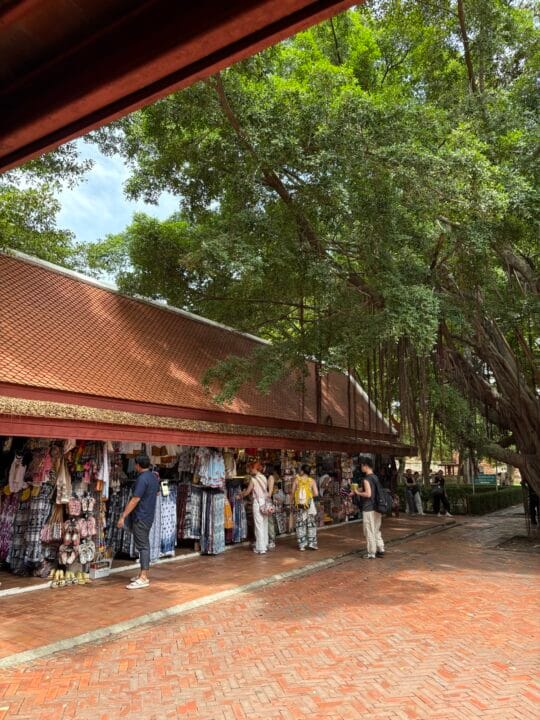
The temple itself is a ruin
Brick remains run on all around. The tops of the towers are said once to have shone gold; the Burmese invasion left it a ruin. Rows of Buddha images stand without their heads.
On the founding there are competing attributions — King Ramesuan in one telling, his predecessor Borommarachathirat I in another. The commonly cited chronology has Borommarachathirat I establishing the temple in 1374 and Ramesuan expanding it in 1384, which is probably why both names attach to it. It is not settled either.
Notes from this visit
- Wat Phra Mahathat (Wat Mahathat) is inside Ayutthaya Historical Park, a UNESCO World Heritage Site since 1991
- The Buddha head held in tree roots is smaller in person than photographs suggest — about the size of a human head
- Photograph it from a kneeling or crouching position so your head is not above it. A guard enforces this
- The origin is disputed. A thief abandoning it and a head falling during the war are both related as accounts
- The founding is variously attributed to Ramesuan and to Borommarachathirat I; commonly cited dates are 1374 and an expansion in 1384
- You can find the head by the crowd. Expect a queue
- We visited a little after 11am
- Opening hours and admission change. Confirm on site
Visited August 2025. Visitor information is as it was at the time of the visit.
The elephant camp from the same day is here.
Related Articles
- Korokke from Hayama Asahiya: thirteen minutes and a Sunday queue
- Design Ah neo Was an Exhibition of Verbs — and It Closed in October 2025
- Why Sendai Gyutan Always Comes With Barley Rice, Oxtail Soup and Miso Nanban
- [Korea] Driving from Busan to Gyeongju: A Look Inside the Oedong King Munmu Expressway Service Area
Comments