I stayed at Mandarin Oriental Tokyo. The conclusion first: what you think of this hotel is decided the moment you reach the 38th floor.
Down at street level, where I handed over the car, I was braced. By the time the lift opened onto the reception floor, that had dissolved. Few buildings change their air this completely from one end to the other.
- At the valet stand, I braced myself
- On the 38th floor, the air changes
- The person who checked me in walked me to the room
- A corner room has windows on two sides
- The corridor is quiet, and the carpet is why
- What it costs: a corner room runs 50–60% above standard
- One MICHELIN Key
- Access and the basics
- In short
- Frequently asked questions
- Read next (nights in Tokyo hotels)
At the valet stand, I braced myself
You hand over the car before anything else. Parked along the drive were a Bugatti and a Ferrari. I arrived in a GLC Coupé. That alone was enough to make me shrink a little.
The attendant was not rude, but there was something stiff about it. Nobody was rushing me, and yet I felt handled. I actually like valet parking, enough that I will drive somewhere because of it — but these few minutes were tense.
At the time I assumed the explanation was structural: this is not the hotel, I thought, it is the building’s car park. The hotel occupies the upper floors of the Nihonbashi Mitsui Tower, so the garage must belong to the building, with a different standard of service.
Then I read the official site, which states that “parking is by valet at the hotel entrance for everyone, not only hotel guests”. So my assumption was wrong. The rate is ¥6,500 per night for guests and ¥500 per 30 minutes otherwise, with free periods tied to spending in the restaurants and spa.
Which means the stiffness was not a difference in systems. It was one person on one day. I am recording it because it happened, not because it says anything about the hotel.
On the 38th floor, the air changes
Inside the hotel, a member of staff took every piece of luggage. The manner was soft. The tension from a minute earlier simply stopped.
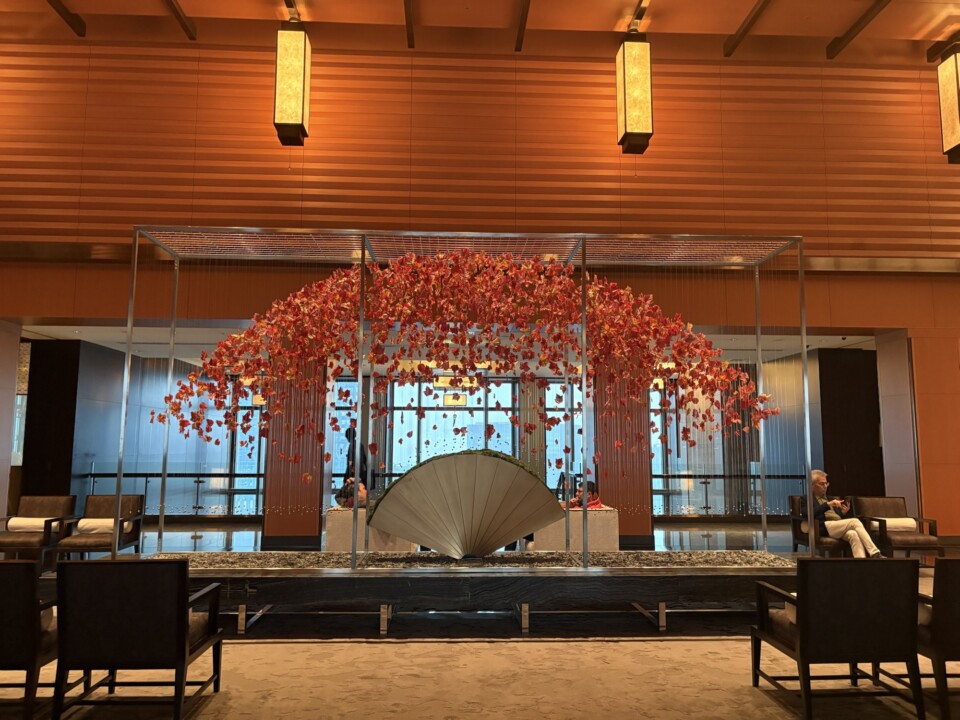
Reception here is on the 38th floor. When the lift doors opened, a monument stood in front of me: hundreds of red maple leaves hanging from above, framed by a wooden lattice and lantern-like lights. It was beautiful.
Guest rooms occupy floors 30 to 36, the spa is on 37. The Aman Tokyo lounge on the 33rd floor in Otemachi does the same thing. Tokyo’s high-rise hotels tend to put the front desk at the top of the climb, and I think the point is to cut the street off entirely.
There was a table of welcome drinks: sake and a non-alcoholic cocktail that day. I took the sake. It was soft, with a sweetness to it, in the same direction as Dassai.
Looking around, almost everyone was a traveller from Europe or North America. Given the Nihonbashi location and this view, that makes sense.
The reception staff were soft too. Not one person who happened to be pleasant, but the same tone running through everyone I met inside the building. That kind of thing shows up at the edges.
The person who checked me in walked me to the room
The member of staff who handled check-in finished the paperwork and then took me up to the room himself.
This is unusual. Normally you are given a key at the desk and that is the end of it, or you are handed to a separate bell staff. It is only the absence of a handover, but from the guest’s side the thread never breaks.
A corner room has windows on two sides
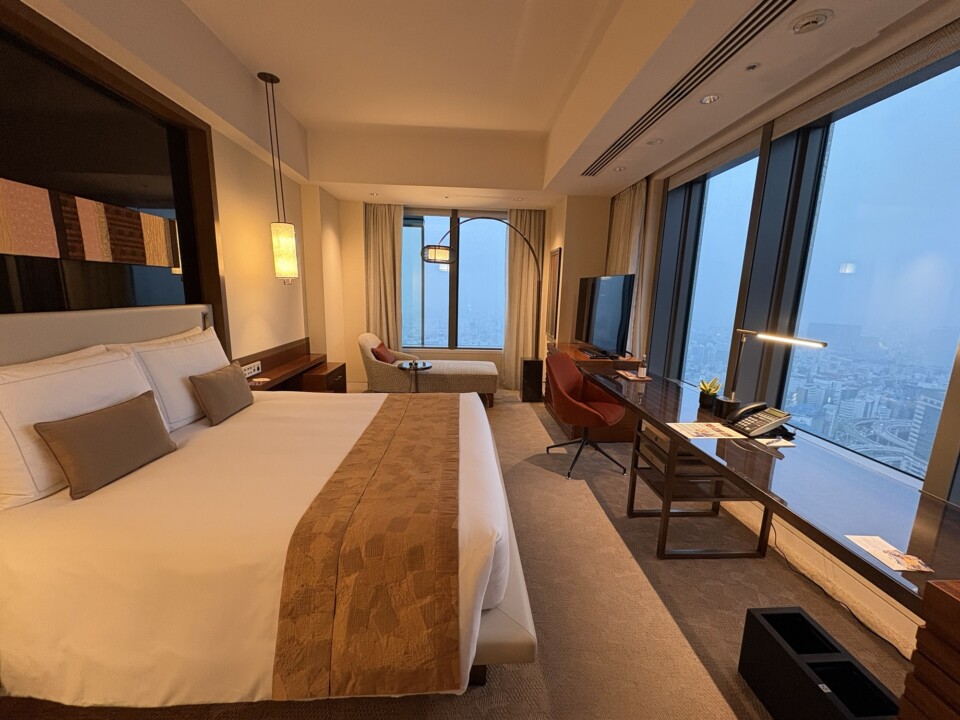
The room was a deluxe corner room. I had booked it about six months ahead.
The floor area is not remarkable. The windows are what matter. Being a corner room, two walls are glass, so the outside is in your field of view wherever you stand. I have no memory of switching a light on during the day.
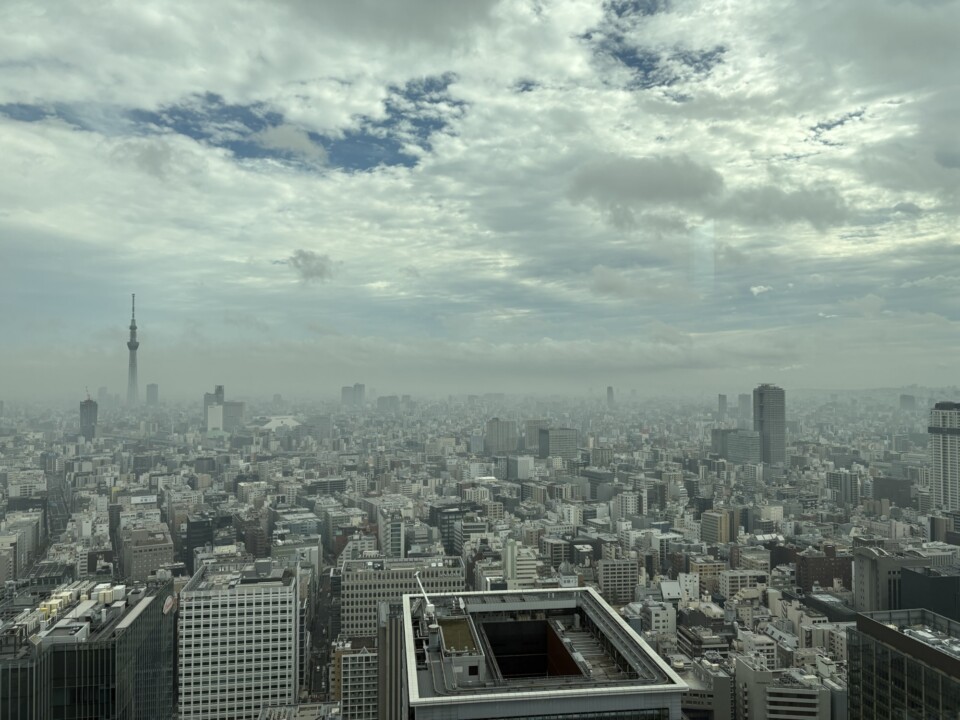
What you see is the northeast. Buildings run to the horizon and Tokyo Skytree stands at the far left. Plenty of rooms in Tokyo look south over the centre; rather fewer high-rise hotels face this direction head on. If it is your first time in the city, this orientation is a good one.
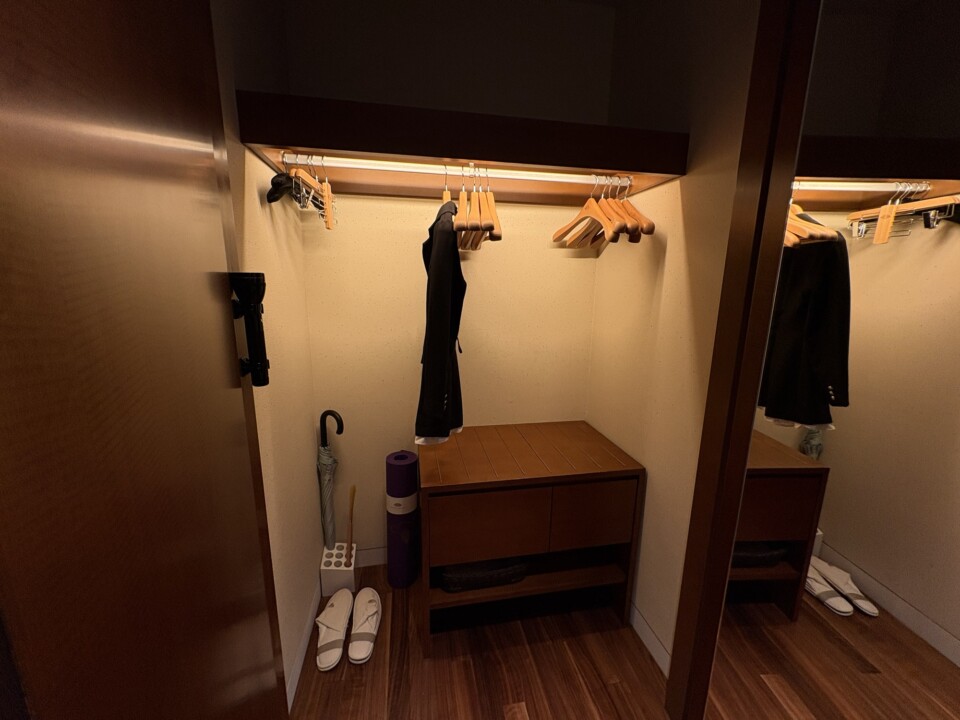
The closet was generous — enough to empty a suitcase into with room to spare. On a stay of several nights, whether this space is adequate has a surprising amount to do with how comfortable the room feels.
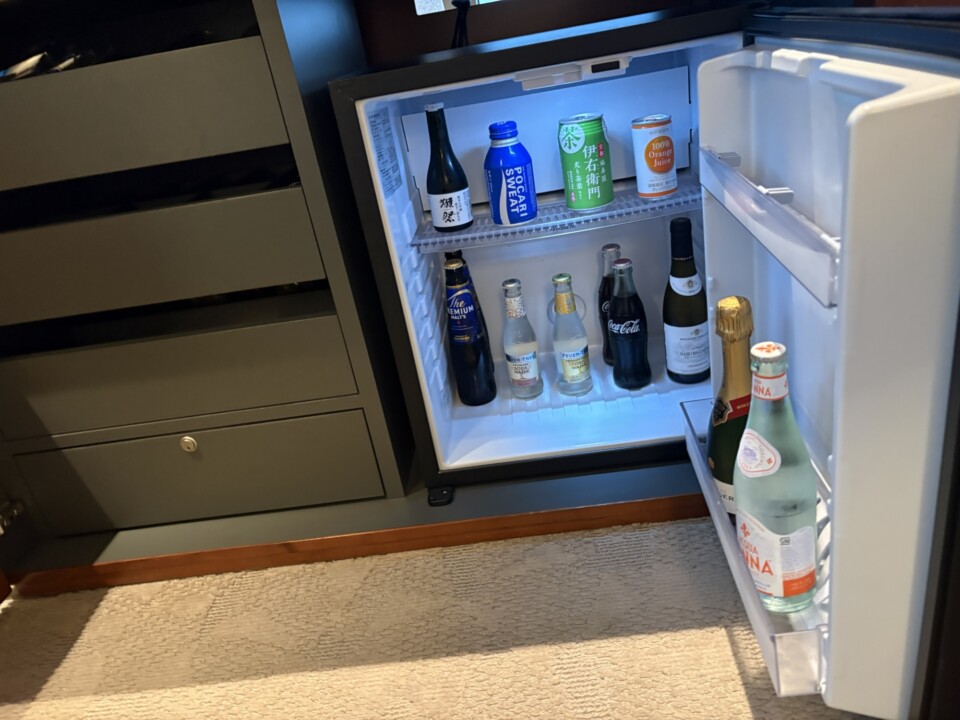
The refrigerator holds the usual range of drinks. What caught my eye was that the wine is there in full bottles, red and white. The glassware ran from soft drinks through to champagne and wine.
Japanese hotel rooms usually offer half bottles, or no wine at all. Stocking a room on the assumption that you will open a bottle in it is not unrelated to how many of the guests here have come from Europe and North America.
The corridor is quiet, and the carpet is why
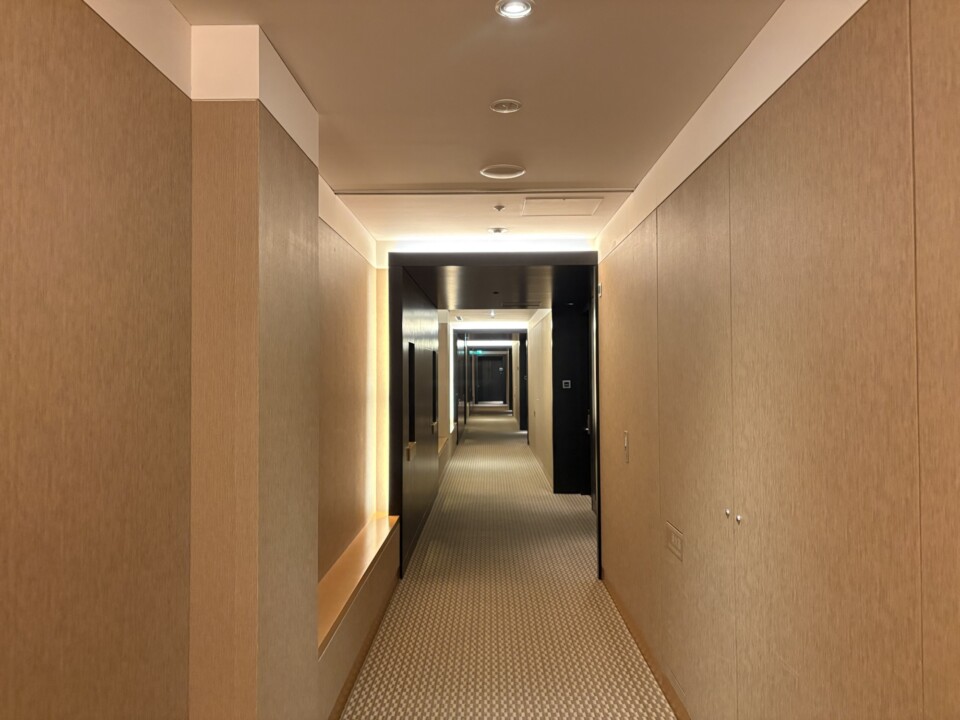
The guest-room corridors were extremely quiet.
The timber walls and indirect lighting play a part, but what is really doing the work is the softness of the carpet. Footsteps are absorbed, to the point that you cannot hear your own. Soundproofing is usually thought of as a job for the walls; the quiet of a corridor is decided by the floor.
What it costs: a corner room runs 50–60% above standard
I booked roughly six months ahead, so what I paid is its own number. What follows is the market rate, which I looked up separately. Searching a weekday night in December at the time of writing gives roughly this ladder (quoted in US dollars, before tax).
- Deluxe (twin): about $950–1,000 per night
- Deluxe Premier (king): about $1,000
- Deluxe King (corner): about $1,550
- Suites: from about $1,740
So a corner room costs 50 to 60 per cent more than a standard deluxe on the same night. The thing this article keeps coming back to — windows on two sides — carries roughly that premium.
Whether it is worth paying depends on how you use the stay. If you are only sleeping there, the standard deluxe is plenty. If you intend to spend daytime hours in the room, two walls of glass earn their keep.
Rates move a great deal with season and day of the week. These are the numbers from one particular night; check the current ones before you book.
One MICHELIN Key
The hotel holds one MICHELIN Key. The MICHELIN Guide’s own page lists it as “One MICHELIN Key · A very special stay” — the hotel equivalent of a restaurant star, introduced as a separate rating.
Having stayed, I can see it. There are hotels whose name is grander than what is behind it; here the standard held from the moment I entered the building to the moment I left. A clear head above, is the honest version.
Access and the basics
- Address: 2-1-1 Nihonbashi Muromachi, Chuo-ku, Tokyo (Nihonbashi Mitsui Tower)
- Opened: 2 December 2005
- Floors: reception 38F / spa 37F / guest rooms 30–36F
- Rooms: 179, of which 22 are suites
- Indicative rates: deluxe about $950–1,000, corner (Deluxe King) about $1,550, suites from about $1,740 (before tax; a December weekday checked at the time of writing)
- Access: direct underground connection from Shin-Nihombashi (JR Sobu Line); direct from Mitsukoshimae (Tokyo Metro Ginza / Hanzomon, exits A7 and A8); 8 minutes on foot from the Yaesu exit of Tokyo Station; 7 minutes from the south exit of Kanda Station; 7 minutes from exit B12 at Nihombashi Station
- Parking: valet at the hotel entrance for everyone, not only guests. ¥6,500 per night for guests, ¥500 per 30 minutes otherwise, with free periods tied to restaurant, spa and banquet spending
- Rating: One MICHELIN Key
In short
- The 38th floor decides it. Whatever you felt at street level dissolves at reception
- All parking is valet. ¥6,500 a night for guests, ¥500 per 30 minutes otherwise
- The person who checked me in walked me to the room himself
- The corner room has windows on two sides, facing northeast, with Tokyo Skytree at the far left
- But a corner room runs 50–60% above a standard deluxe. If you are only sleeping, take the standard
- Wine in the refrigerator comes in full bottles, and the glassware goes up to champagne
- The guest-room corridors are quiet. The carpet absorbs footsteps
- One MICHELIN Key
Frequently asked questions
What does a night cost?
Checking a weekday night in December at the time of writing: deluxe (twin) about $950–1,000, Deluxe Premier (king) about $1,000, the Deluxe King corner room about $1,550, and suites from about $1,740 — all before tax, quoted in US dollars. A corner room therefore works out 50 to 60 per cent above a standard deluxe. Rates move sharply with season and day, so check before booking.
Which floor is reception on?
The 38th. Reception sits at the top of the lift ride, with a monument of suspended red maple leaves beside it. The spa is on 37, and guest rooms occupy floors 30 to 36.
Is there parking, and what does it cost?
There is, but you do not park it yourself. The official site states that parking is by valet at the hotel entrance for everyone, not only hotel guests. It is ¥6,500 per night for guests and ¥500 per 30 minutes otherwise. Spa treatments cover the time free, banquets and weddings cover up to four hours, and restaurants cover a period that varies with what you spend. Check the current terms on the official site.
Which station is closest?
Shin-Nihombashi on the JR Sobu Line connects underground, and Mitsukoshimae on the Tokyo Metro Ginza and Hanzomon lines connects directly from exits A7 and A8. It is 8 minutes on foot from the Yaesu exit of Tokyo Station, 7 from the south exit of Kanda, and 7 from exit B12 at Nihombashi.
What can you see from a corner room?
My room faced northeast: buildings to the horizon with Tokyo Skytree at the far left. Two walls are glass, so the view is in front of you wherever you are in the room. Orientation varies by room, so if the view matters, confirm it when you book.
Does it hold a MICHELIN Key?
One Key. The MICHELIN Guide’s official page lists it as “One MICHELIN Key · A very special stay”.
What is in the room refrigerator?
Sake, soft drinks and mineral water, plus wine in full bottles, red and white. Glassware runs from soft drinks through to champagne and wine. Contents can change.
Read next (nights in Tokyo hotels)
- Drive to The Westin Tokyo: the valet parking is the reason
- You Can See Tokyo Tower From the Pool: ANA InterContinental Tokyo
- Aman Tokyo Afternoon Tea: The Black Bamboo Tray, and Why 11:00 Is the Seating to Book
Stayed October 2026. Floor layout, room count and opening date are from the hotel’s published information; parking rates and access are from the official site; the MICHELIN Key is from the MICHELIN Guide’s official page. The indicative room rates come from a hotel booking site at the time of writing, for a weekday night in December, and are not what I paid. Rates and facilities change — check the official site for the current position.
Related Articles
- Four nights at The St. Regis Bangkok: the window was a field of green
- Canes & Tales, Waldorf Astoria Osaka: Go at 5pm, Stay Until It Gets Dark
- Kamogawa Grand Tower: only one room in the building has a jacuzzi
- Yamaroku Shoyu on Shodoshima: a wooden-barrel brewhouse home to a hundred microbes, and ice cream with soy sauce
Comments