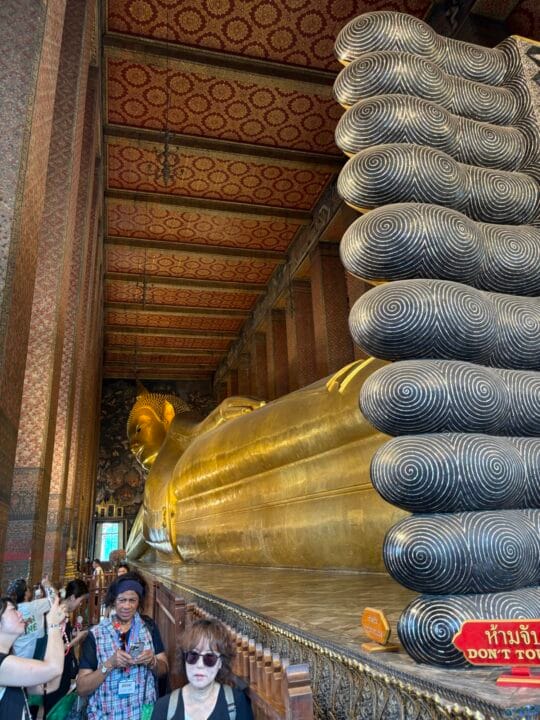
In one day I saw the temple that commemorates a victory and the temple that was destroyed in a defeat, one after the other. That this was the order of it only struck me afterwards.
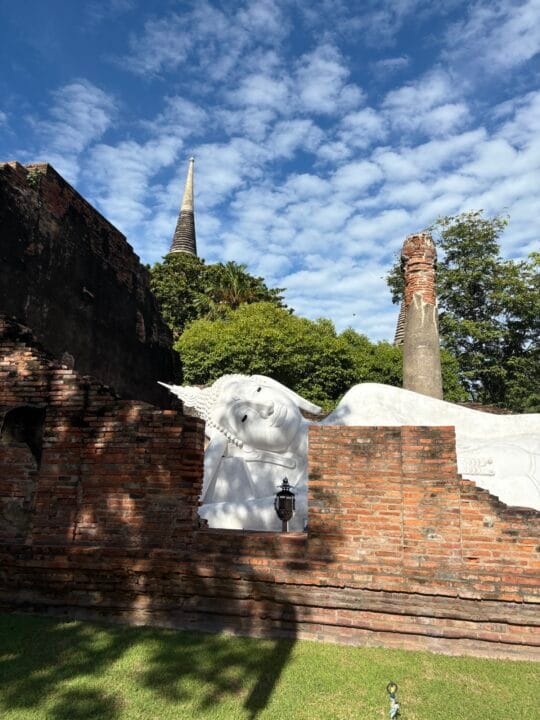
Half past eight, in front of a white reclining Buddha
The first place we entered in Ayutthaya was Wat Yai Chai Mongkhon, a little after half past eight.
In one corner of the grounds a reclining Buddha wrapped in white cloth lies out in the open. There is no roof. It sits under the blue sky with brick ruins running behind it, and the morning light was falling straight onto it.
The monastery was founded in 1357 by King U-Thong, who established Ayutthaya, for monks who had studied in Ceylon — present-day Sri Lanka — to meditate in.
The tower is a monument to a win
A large chedi stands at the centre of the grounds. It is commonly given as about 72 metres, the tallest in the city.
It was built in 1592, commemorating King Naresuan’s victory in single combat on elephant-back against the crown prince of Burma — the Maha Uparacha of Hongsawadi. The fate of a country decided in a duel on top of elephants, turned directly into a tower.
That same morning I had been on an elephant’s back myself, alone on a saddle built for two, struggling with the sway. Picturing a fight up there changes how real the story feels.
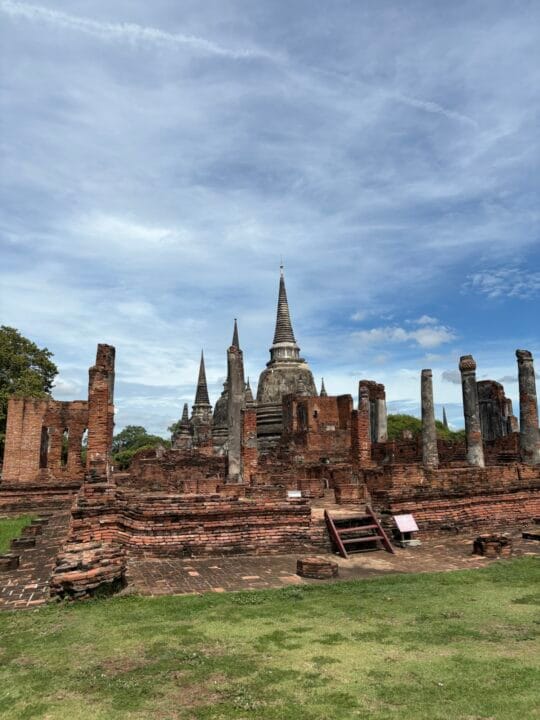
Half past ten, to the place where three towers stand in a row
Next was Wat Phra Si Sanphet. Three bell-shaped chedis stand at even intervals on a brick platform.
This was the most important temple inside the Ayutthaya royal palace — the equivalent, in Bangkok terms, of the Temple of the Emerald Buddha. King Borommatrailokkanat converted the old palace grounds into a holy site in 1448. The chedis came later: two in 1492 for the ashes of Borommatrailokkanat and King Borommaracha III, and a third in 1529, under Borommaracha IV, for King Ramathibodi II. All three hold kings, not princes.
The temple’s name comes from the Buddha image that once stood here. A standing figure 16 metres tall on an 8-metre pedestal, commissioned by Ramathibodi II — a bronze core of roughly 64 tonnes under about 343 kilograms of gold, and more than three years in the making. It was called Phra Si Sanphet.
In 1767, all of it was destroyed
The image is not here now. In the second Burmese invasion of Ayutthaya in 1767 the building was set on fire and the gold melted off. Two of the chedis were destroyed; the eastern one survived. What you see today was restored by Thailand’s Fine Arts Department in 1956.
The 72-metre tower I had seen that morning was a monument to beating Burma. About 175 years later, the same opponent burned the capital. Walk the two temples in sequence and the drop between them is laid out on the ground.
I had thought of ruins as places where time has stopped. What is actually left is the order in which the wins and losses happened.
Notes from this visit
- Both temples are in Ayutthaya Historical Park, a UNESCO World Heritage Site since 1991
- Wat Yai Chai Mongkhon was founded in 1357 by King U-Thong, for monks returned from Ceylon
- Its great chedi, commonly given as about 72 m and the tallest in the city, was built in 1592 to mark King Naresuan’s elephant-back victory over Burma’s crown prince
- A reclining Buddha wrapped in white cloth lies in the open air
- Wat Phra Si Sanphet: the palace grounds were converted by King Borommatrailokkanat in 1448; the three chedis date from 1492 (two) and 1529 (one)
- The chedis hold the ashes of Kings Borommatrailokkanat, Borommaracha III and Ramathibodi II
- The Phra Si Sanphet image stood 16 m on an 8 m pedestal: a bronze core of about 64 tonnes under roughly 343 kg of gold
- Destroyed in the second Burmese invasion of 1767; restored by the Fine Arts Department in 1956
- We visited at about 8:30 and about 10:30
- Hours and admission change. Confirm on site
Visited August 2025. Visitor information is as it was at the time of the visit.
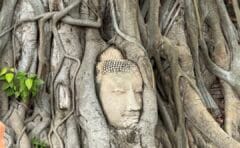
Also from this day: the Buddha head in the tree roots and the elephant camp.
Comments