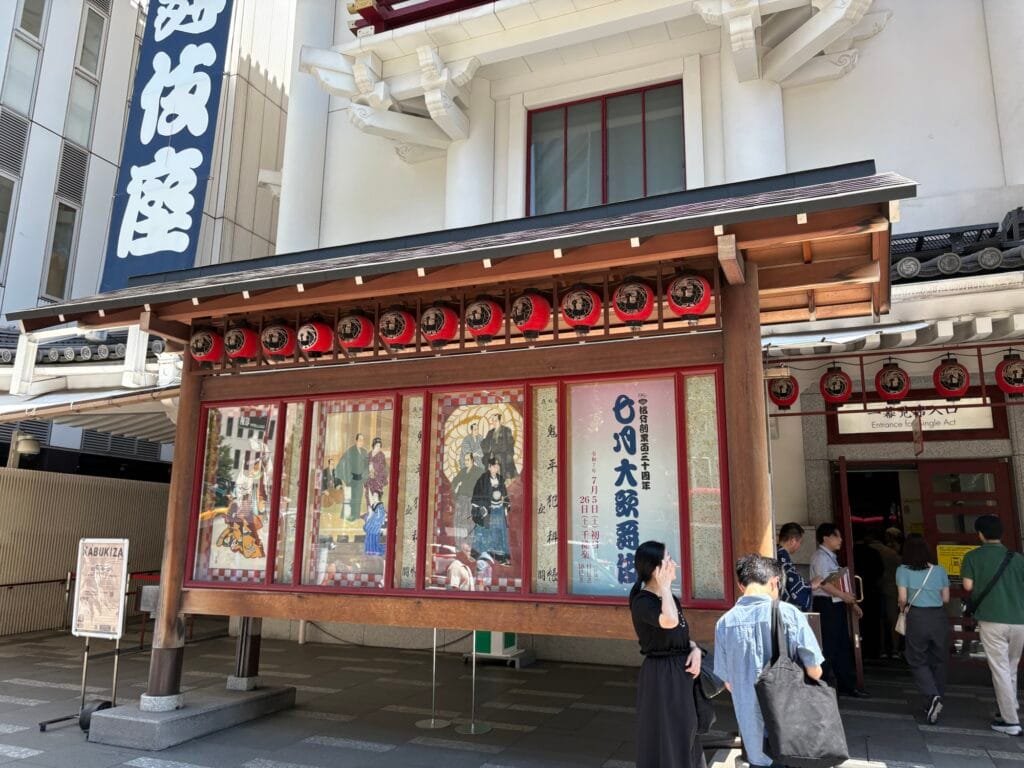
On 26 July 2025 I went to the matinee at the Kabuki-za. I had almost no experience of kabuki.
Looking back at the photographs afterwards, I realised it had been senshūraku — the closing day of the run. That was not planned; it was chance. But it probably explains why the air outside the theatre felt different the moment I arrived.
The red banner that reads “closing day”
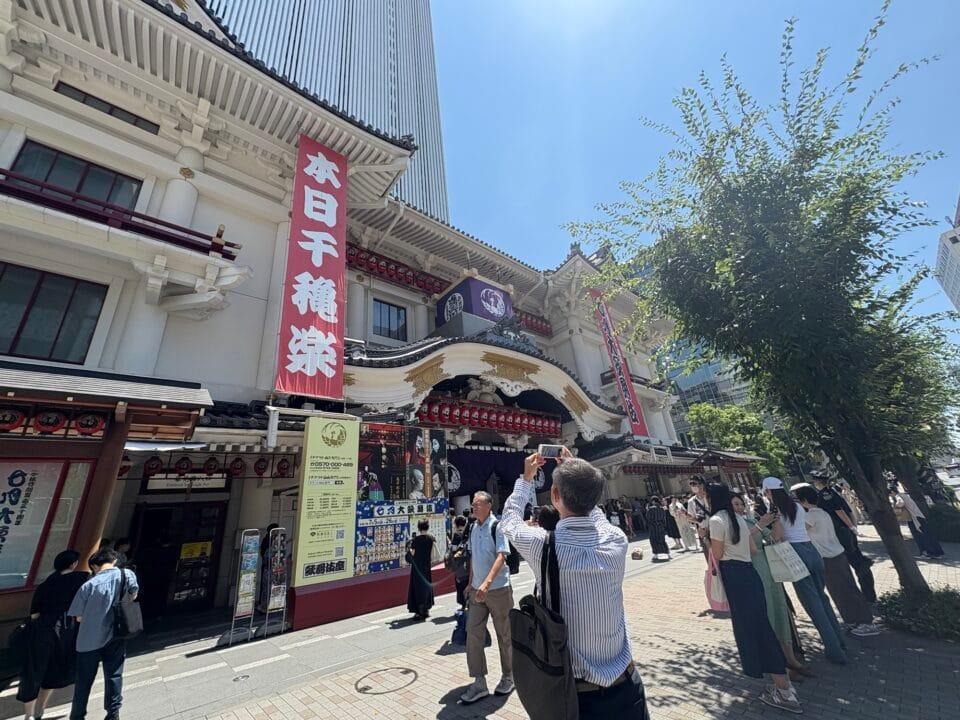
10:41, Higashi-Ginza.
On the white wall of the Kabuki-za facing Harumi-dōri hung a large red banner reading 本日千穐楽 — “today is the closing day.” Beside it, the swooping karahafu gable of the roof. In front, a ginkgo tree and a queue of people waiting for the doors.
Even if you cannot read the characters, the fact that a red banner is flying tells you today is a special day. That is a good piece of signalling.
Everyone stops at the painted boards
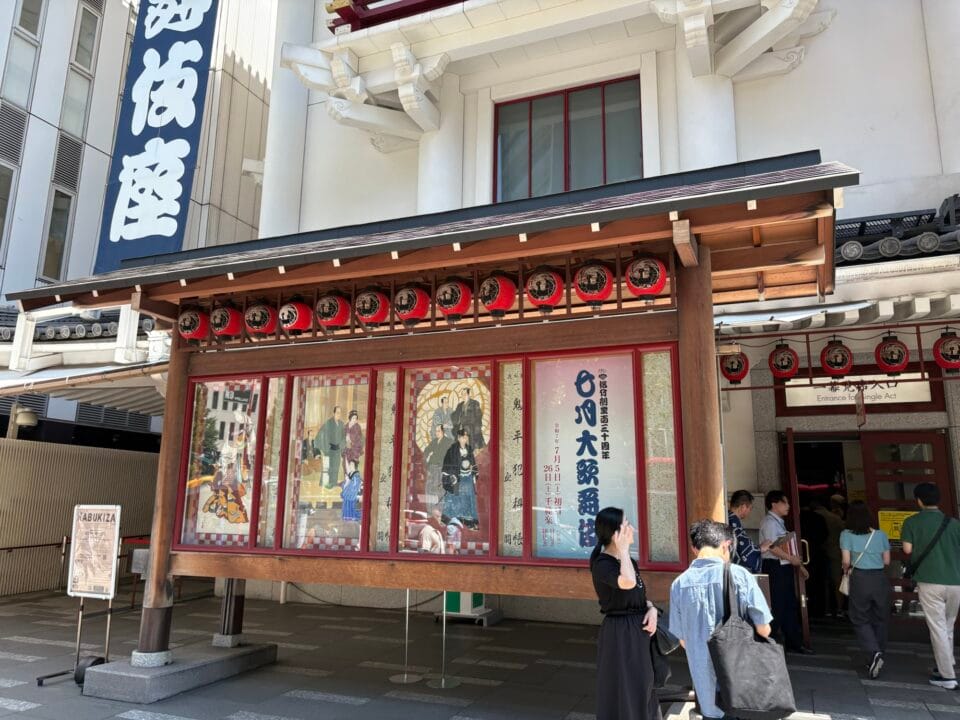
10:42. Round at the front, red lanterns hang in a long row under the eaves.
Below them, in a large glass case, are the e-kanban — tall painted boards showing scenes from the programme, with “July Grand Kabuki” lettered beside them.
Almost everyone stopped here to take a photograph. Even knowing nothing about the plays, the paintings tell you something is about to happen. The device that gets you invested without any preparation is already working at the entrance.
Inside
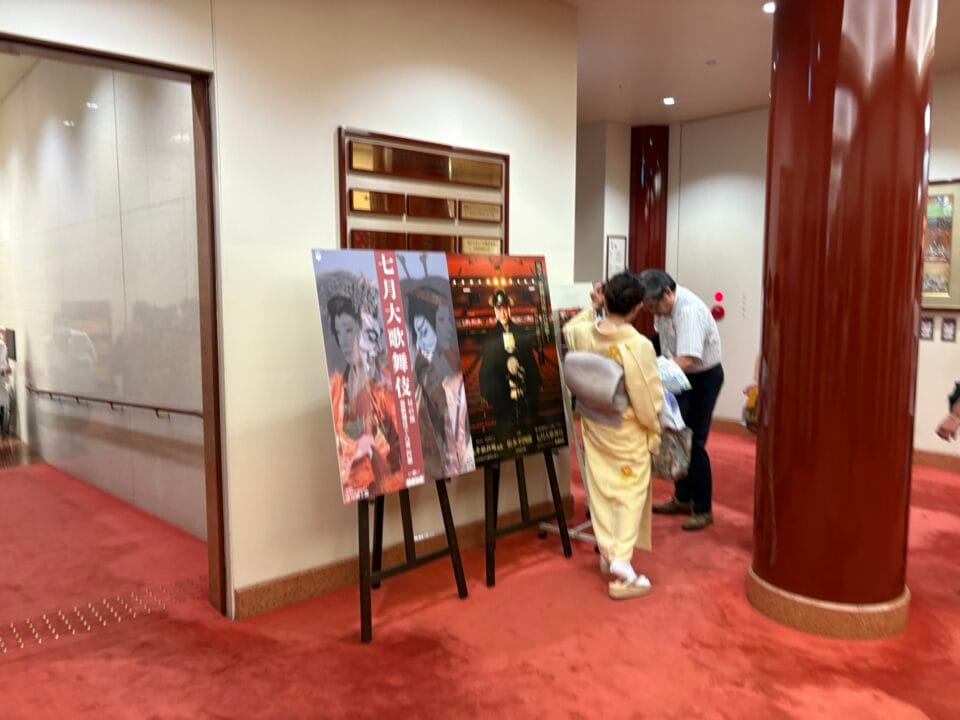
10:43, through the doors.
Red carpet on the floor, vermilion pillars, easels along the walls holding programme posters. A scattering of people in kimono, not standing out but simply part of the scene.
I had braced myself, and the atmosphere inside was far more ordinary than expected. You will not look out of place in everyday clothes. In fact most people are in everyday clothes.
The curtain in black, persimmon and green
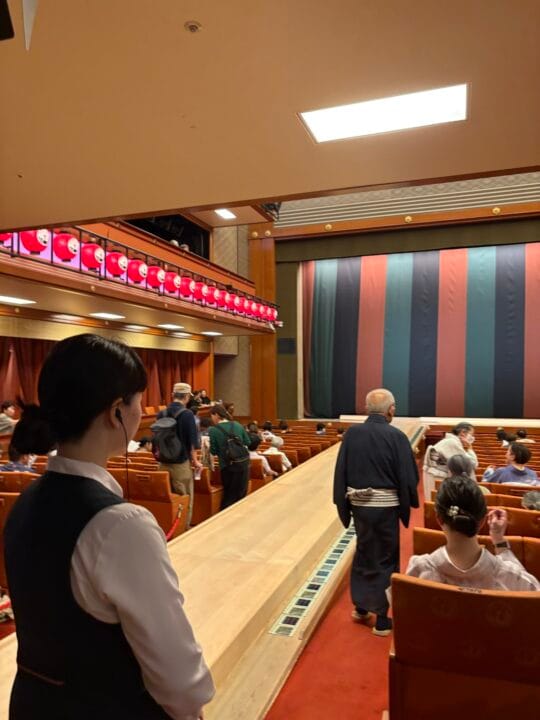
10:44. In my seat, facing forward — this one I already knew.
Covering the stage is the jōshiki-maku, the vertical tricolour of black, persimmon orange and light green that is the signature of the Kabuki-za.
Look up towards the auditorium and there are red lanterns again, running along the edge of the second tier. Lanterns outside and lanterns inside: the whole building holds to one visual idea.
I liked the time spent just looking at that curtain. Nothing has begun, and yet three colours are enough to tell you where you are.
At the interval, a queue for sweets
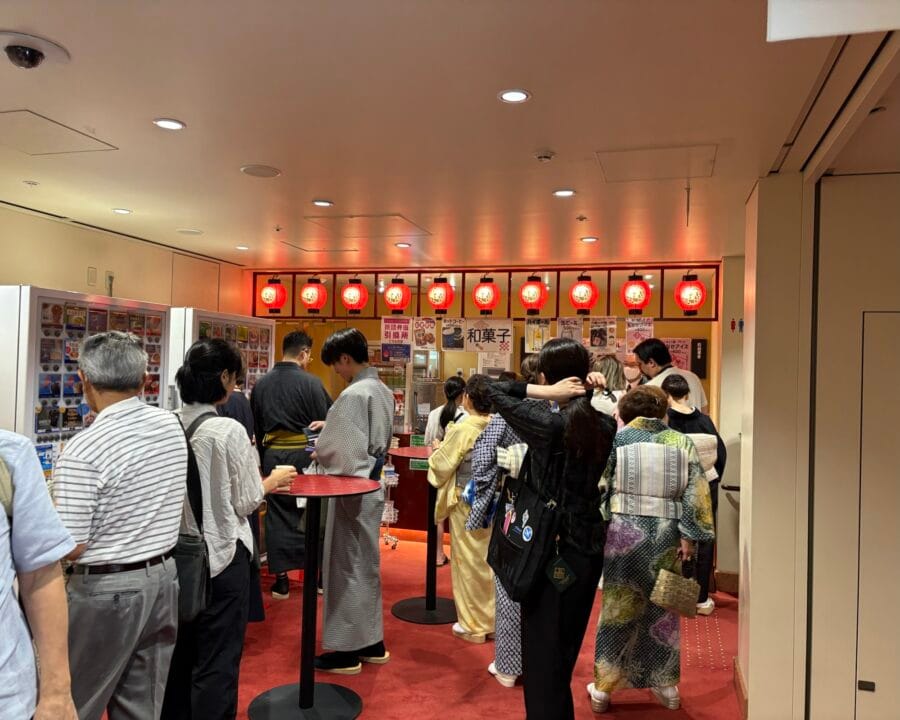
11:56, makuai — the interval.
This is where I felt I saw what the Kabuki-za actually is. The counters were packed.
Red lanterns overhead, a sign reading “wagashi” on the wall, and people in kimono, in yukata and in ordinary clothes all mixed together, all buying something. Small round tables where people stand and eat.
A kabuki interval is not the same thing as a break at the cinema. The interval behaves like part of the programme: you eat something, you talk, you go back to your seat. That rhythm of leaving and returning is what shapes the experience.
If it is your first time, decide in advance what you are going to buy at the interval. Put it in the plan.
The stage from the seats
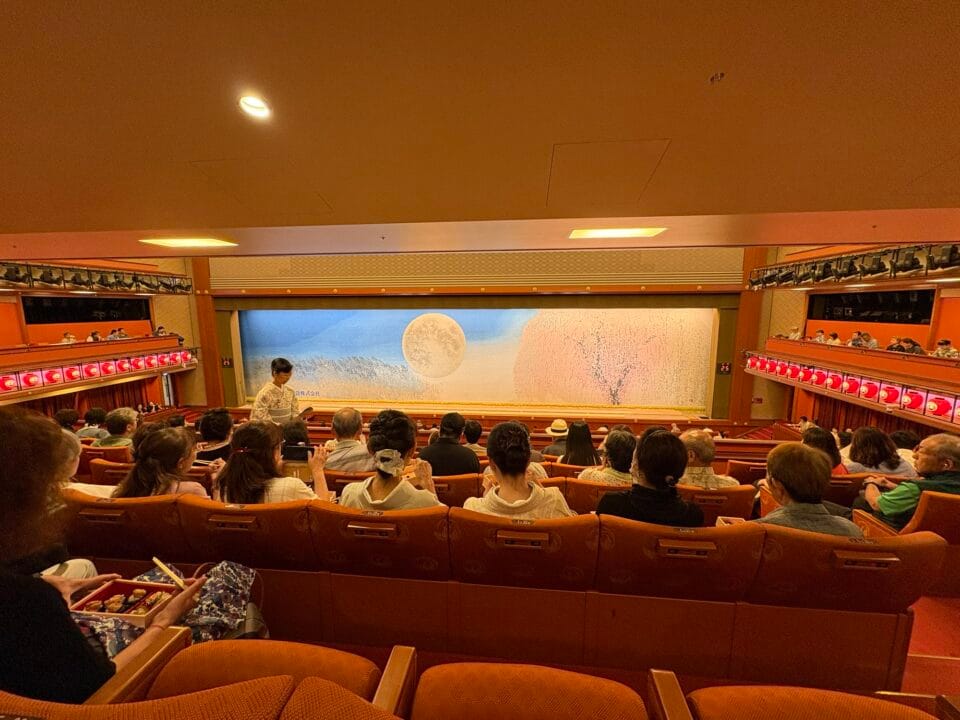
12:00. The rake of the seats, and the stage beyond. The backdrop was a large painted moon with branches across it.
The seats are tighter than you might expect — there is none of the legroom of a modern theatre. But that packs the audience into a single mass, and laughter and applause travel through it easily.
For the avoidance of doubt: photography and recording are prohibited during the performance.
Notes for a first visit
- Date: Saturday 26 July 2025, the matinee of July Grand Kabuki. It happened to be the closing day
- Venue: Kabuki-za, 4-12-15 Ginza, Chuo-ku, Tokyo. Directly connected to Higashi-Ginza station on the Tokyo Metro Hibiya line and Toei Asakusa line — you can enter without going up to street level
- Dress: everyday clothes are fine. Some people wear kimono, but they are a minority and neither choice stands out
- Closing day or not: the last day has a different atmosphere, but it is also busier. For a calmer visit, pick a weekday mid-run
- Single-act seats: the Kabuki-za sells tickets for one act only. For a first visit that can be a better starting point than the full programme — check the official site for how and when they go on sale
- The interval is part of the experience. The sweet and bento counters get crowded, so know what you want
- Photography is allowed in the auditorium and lobby but not during the performance
- Reading a synopsis beforehand makes it dramatically easier to follow. That said, the painted boards, the costumes and the movement carry a surprising amount on their own
- The matinee runs several hours including intervals. Leave room in the day either side
I had assumed kabuki was forbidding. What I learned by going is that the barrier is entirely outside the building. Once you are through the doors there are only red lanterns, a three-coloured curtain, and a queue for sweets at the interval.
Programmes, prices and ticketing change from run to run. Check the Kabuki-za official site for current information.
FAQ: A first visit to the Kabuki-za
How do I get to the Kabuki-za?
It stands at 4-12-15 Ginza, Chuo-ku, Tokyo, directly connected to Higashi-Ginza station on the Tokyo Metro Hibiya line and the Toei Asakusa line. You can walk in without coming up to street level.
Is there a dress code?
Everyday clothes are fine. Some people wear kimono, but they are a minority and neither choice stands out. I arrived braced for formality and found the atmosphere inside far more ordinary than I expected.
Should a first-timer buy single-act seats?
The Kabuki-za sells tickets for one act only. A full programme runs several hours, so a single act can be an easier first step. How and when they go on sale changes by run — check the official site.
Is the closing day worth aiming for?
The last day does feel different. Mine happened to be one, and a red banner reading senshuraku hung on the front of the building. But it is also busier, so for a calmer visit pick a weekday in the middle of the run.
What happens during the interval?
The interval is part of the experience. There are counters selling Japanese sweets and bento, and they get crowded — decide what you want before you queue.
Can I take photographs?
You may photograph the auditorium and the lobby, but photography and recording are not allowed during the performance.
Do I need to read the synopsis in advance?
It makes following the play dramatically easier. That said, even without it, the painted boards at the entrance, the costumes and the movement carry a great deal of the story.
Visited in July 2025. Prices, programme and ticketing details are as they were at the time — please check the official site for the latest information.
More from Ginza and central Tokyo
- Ginza Sembikiya Fruit Parlour: Eating Upstairs from a Fruit Shop
- The Tokyo Marriott Depends Entirely on Lounge Access
- BEAR ART TOKYO Is in Kuramae, Not Asakusa
📖 A companion guide from Private Wisdom
Planning your trip? How to Plan a Trip to Japan — how many days you need, where to base yourself, and how to build an itinerary that actually works, from a long-time local. Free to read with Kindle Unlimited.
▶ Read on Amazon (Kindle Unlimited)Related Articles
- [Gyeongju] Walking Bulguksa Temple: The Pagoda on the 10-Won Coin and a Pond of Water Lilies
- [Busan] A Container-Built Miffy Cafe on Yeongdo, With a Terrace Over the Harbor
- Busan, August 2026: the Westin Chosun, a Temple on the Sea, a Live Octopus, and the Blue Line Park at Night
- Marina Bay Sands Is Better Seen From Across the Bay, Not From the Top


Comments