Get off at Tha Tien and there is a temple on either side of you. Wat Arun across the river, Wat Pho on the bank you landed on. That morning we walked both.

9:17, looking up at the stairs
Standing under the prang of Wat Arun, my first thought was: we are climbing that?
The stairs are steep. The treads are shallow and the angle is such that you cannot go up without holding the rail. The surface of the tower is covered in countless fragments of porcelain, and close up you can see each one is shaped like a flower. From a distance it reads as a white tower; in fact it is an assembly of small colours.
At the foot of the stairs there is a warning sign, in Thai, Korean, Chinese and German. Watch out for pickpockets. That sign alone tells you this is a place the whole world comes to.

The name comes from the god of dawn
Wat Arun is called the Temple of Dawn. The name derives from Aruna, the Hindu deity, and from there the association with daybreak.
The temple itself existed from at least the seventeenth century. The distinctive tower now in front of you was built in the early nineteenth, in the reign of Rama II. Rama I died without seeing it finished, the next reign took it over and completed it, and it was at that point that it took the name Wat Arun Ratchawararam.
A major restoration ran from 2013 to 2017. The whiteness I was looking at is the whiteness after that work.
11:20, meeting a 46-metre Buddha
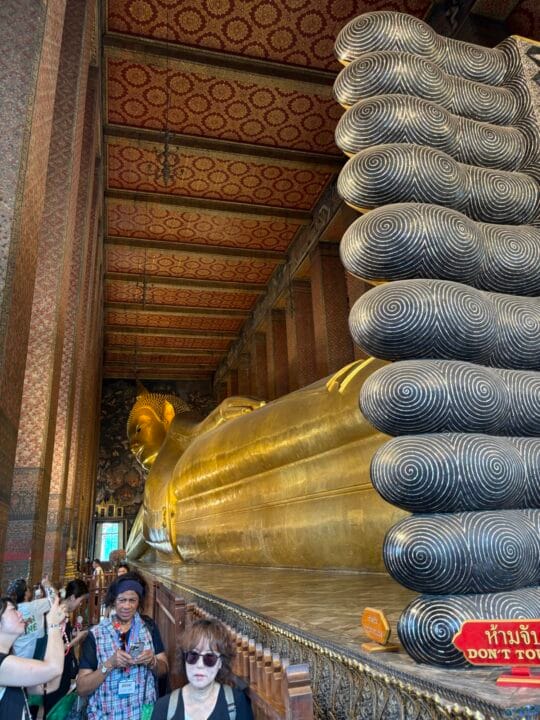
We came back across the river and went into Wat Pho a little after twenty past eleven.
Enter the hall and your whole field of view is filled. The reclining figure is 46 metres long and 15 metres high. You are too close to see the whole of it, so you check it by walking from the head to the feet.
The soles are the thing to see. They are inlaid with mother-of-pearl, each divided into 108 panels carrying the auspicious symbols by which the Buddha is identified — flowers, dancers, white elephants, tigers, altar objects. At the end of an enormous gold body, one surface packed with fine work. Astonish you with the scale, then close with the detail.
It was Thailand’s first university
This is a royal temple. Rama I began its reconstruction in 1788, for the study of monks; Rama III started renovating and enlarging the complex in 1832 and completed the chapel of the reclining Buddha. During that work, the content of scholarly texts across many fields was inscribed around the temple — to spread knowledge among ordinary people, which is why Wat Pho is considered Thailand’s earliest centre of public education, its first university.
Those marble illustrations and inscriptions were entered on the UNESCO Memory of the World register on 21 February 2008.
It was a seat of medicine too. That is why it is regarded as the home of traditional Thai massage; a school of traditional medicine and massage was established here in 1955, the first such institution approved by Thailand’s Ministry of Education, and you can still be treated on the grounds.
Behind the reclining Buddha that everyone knows, there is a history as a school. Thinking about the people who set out to preserve knowledge by cutting it into stone, the temple looks slightly different.
Notes from this visit
- Both are reached from Tha Tien pier (N8). Wat Pho is immediately by the pier; Wat Arun is across the river by the cross-river ferry
- The stairs on the Wat Arun prang are genuinely steep — you will be using the handrail
- The tower is skinned in porcelain fragments; up close they are flower-shaped
- The name comes from the Hindu deity Aruna. The present tower dates from the early nineteenth century, the reign of Rama II. Restored 2013–2017
- Wat Pho’s reclining Buddha is 46 m long and 15 m high; the soles carry 108 mother-of-pearl panels
- Wat Pho is considered Thailand’s first university, and its inscriptions joined the UNESCO Memory of the World register on 21 February 2008
- It is the home of traditional Thai massage; the school there was founded in 1955
- We went round from a little after 9am to about 11:30
- Hours, admission and dress rules change. Confirm on site
Visited August 2025. Visitor information is as it was at the time of the visit.
Getting there: the Chao Phraya ferry. Afterwards: mango and sticky rice.
Comments