I had heard that QR payment is everywhere in Thailand. It is — the codes hang in shopfronts and on street stalls. And I could not use one, not once.
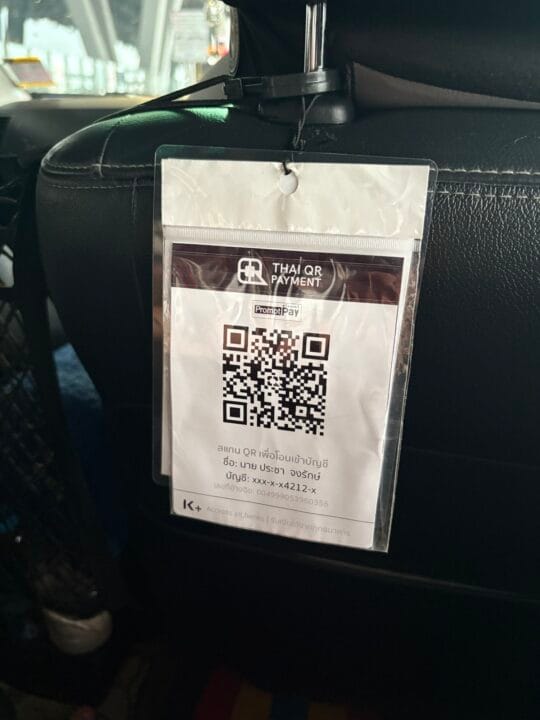
- The codes hang everywhere
- And still it would not open for a tourist
- So what do you do
- Notes
- Frequently asked questions
- Can a tourist use QR payment in Thailand?
- Why does it not work?
- Which countries’ visitors can scan a Thai QR code?
- Is Japan on that list?
- So “QR payment is widely adopted in Thailand” is wrong?
- What did you pay with instead?
- How much cash should I change?
- Is there a tourist-facing alternative?
- Is this still accurate?
The codes hang everywhere
I took this on the evening we arrived: a paper QR code strung from a post. No special machine, no tablet. One sheet of paper and the payment happens.
You see this all over Bangkok. Small shops, the street, the same everywhere.
And still it would not open for a tourist
From my side, it did not work. Scan it and nothing proceeds.
At the time I assumed some local ID was required. Looking it up afterwards, that was close to right.
What sits at the centre of Thai QR payment is PromptPay, and it is tied to a Thai domestic bank account. Without an account you are not standing at the entrance to registration in the first place. The merchant’s QR is readable; there is simply no mechanism on the paying side.
There is a further detail I only found later, and it is the actual answer. The Bank of Thailand runs cross-border QR linkages, and inbound tourists from Cambodia, Malaysia, Vietnam, Indonesia, Hong Kong, Lao PDR, Korea and China can scan Thai QR codes with their home apps. Japan is not on that inbound list. The Japan link runs the other way: Thai travellers can pay Japanese merchants using MyPromptQR. So a visitor from Seoul can scan the paper on the post and a visitor from Tokyo cannot — not a fault in my phone, a gap in the rails.
“It is widely adopted” and “a tourist can use it” turned out to be two different statements.
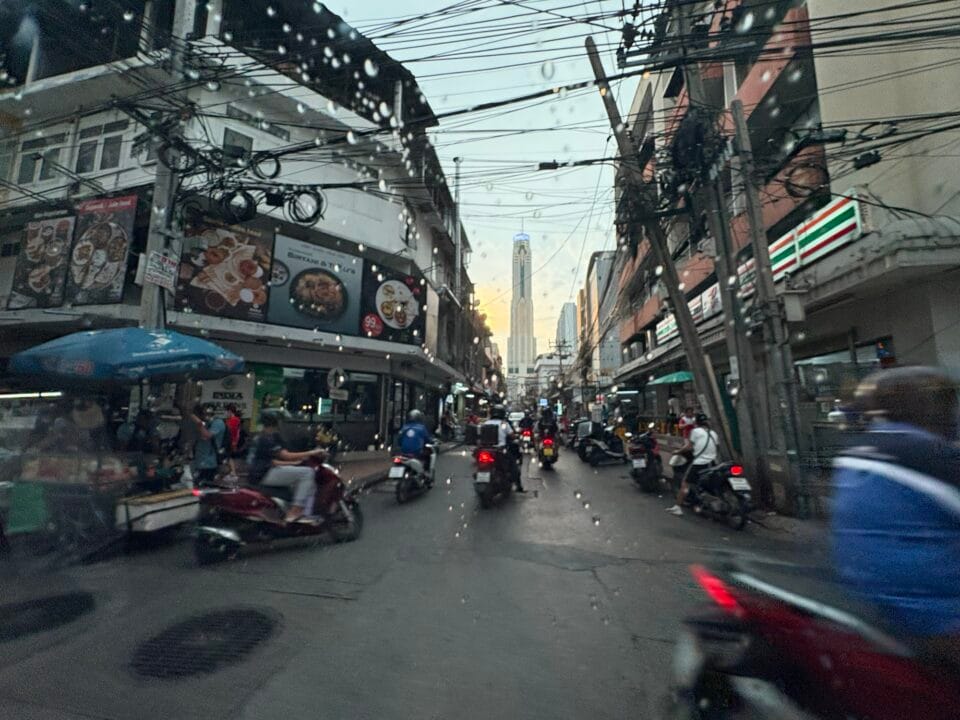
So what do you do
I ran the trip on cash and credit cards, and in the end there was almost no moment where that was a problem. Hotels, restaurants and malls all take cards. Cash is for street stalls and small shops.
There are options aimed at tourists, though. TAGTHAi Easy Pay is an e-wallet developed with support from the Tourism Authority of Thailand: you collect a prepaid card at a Kasikorn Bank exchange counter, set it up in the app, and it is said to work at merchants that accept QR payment. Next time, I intend to try it.
Notes
- QR payment is genuinely widespread in Thailand — paper codes at shopfronts and on the street
- The core scheme is PromptPay, which requires a Thai domestic bank account, so a tourist cannot register
- Bank of Thailand cross-border linkages let inbound visitors from Cambodia, Malaysia, Vietnam, Indonesia, Hong Kong, Lao PDR, Korea and China scan Thai QR codes with their home apps. Japan is not on the inbound list; the Japan link is outbound-only (Thai travellers paying in Japan via MyPromptQR)
- Cash and credit cards cover a tourist fine. Cards fail only at street stalls and small shops
- TAGTHAi Easy Pay, an e-wallet backed by the Tourism Authority of Thailand, is the tourist-facing alternative
- Change money on arrival, only what you need. Carrying no cash at all is a bad idea
- Payment arrangements move quickly, and the Bank of Thailand says it expects to add partner countries. Check current information before you fly
Travelled August 2025. Payment arrangements change; this reflects what could be confirmed at the time of writing.
More from this trip
- I left the airport in Thailand without buying a SIM
- POP MART at ICONSIAM: the one I wanted was sold out
Frequently asked questions
Can a tourist use QR payment in Thailand?
Not with a Japanese phone, in my experience. The codes are everywhere — paper QR codes strung from posts, at shopfronts and on street stalls — but when I scanned one, nothing proceeded. Not once, on the whole trip.
Why does it not work?
The core scheme is PromptPay, and it is tied to a Thai domestic bank account. Without an account you are not standing at the entrance to registration in the first place. The merchant’s QR is readable; there is simply no mechanism on the paying side.
Which countries’ visitors can scan a Thai QR code?
The Bank of Thailand runs cross-border QR linkages. Inbound visitors from Cambodia, Malaysia, Vietnam, Indonesia, Hong Kong, Lao PDR, Korea and China can scan Thai QR codes with their home apps.
Is Japan on that list?
No. Japan is not on the inbound list. The Japan link runs the other way: Thai travellers can pay Japanese merchants using MyPromptQR. So a visitor from Seoul can scan the paper on the post and a visitor from Tokyo cannot — not a fault in my phone, a gap in the rails.
So “QR payment is widely adopted in Thailand” is wrong?
It is correct, and it is a different statement from “a tourist can use it.” Both are true at the same time.
What did you pay with instead?
Cash and credit cards, and in the end there was almost no moment where that was a problem. Hotels, restaurants and malls all take cards. Cash is for street stalls and small shops.
How much cash should I change?
Change money on arrival, and only what you need. Carrying no cash at all is a bad idea, because that is exactly where cards stop working.
Is there a tourist-facing alternative?
TAGTHAi Easy Pay is an e-wallet developed with support from the Tourism Authority of Thailand. You collect a prepaid card at a Kasikorn Bank exchange counter and set it up in the app, and it is said to work at merchants that accept QR payment. I did not try it on this trip; I intend to next time.
Is this still accurate?
Payment arrangements move quickly, and cross-border linkages are added over time. Treat this as a record of what I ran into on my trip, and check the current position with Bank of Thailand, your card issuer or the operator’s official information before you travel.
Visited in August 2025. Payment arrangements and details are as of my visit.
Related Articles


Comments