Here is the conclusion first. For Motomachi, one tram line is enough.
Hachimanzaka, the old public hall and the red brick warehouses all sit along a single streetcar route. Drop your bags at a hotel by the station, get on the tram, walk up the hill. That was the whole of this day.
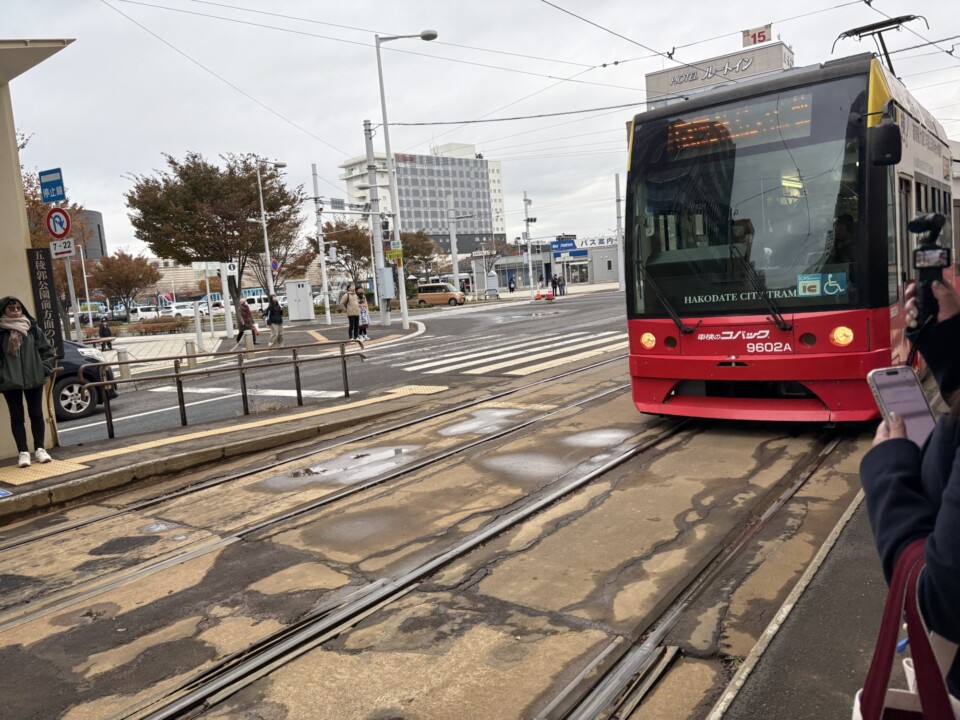
A city that kept its streetcar
Central Hakodate is long and thin, squeezed between the sea and the hills, and the tram runs along that thinness. Geography and route coincide, so getting anywhere means riding, getting off and walking.
Nothing goes underground the way it does in Sapporo. The city is visible the entire time you are on board. The journey is part of the sightseeing, which is a value distinct from efficiency.
From the stop to the sights you will be walking uphill. Motomachi is built on a slope. Wear shoes you can climb in.
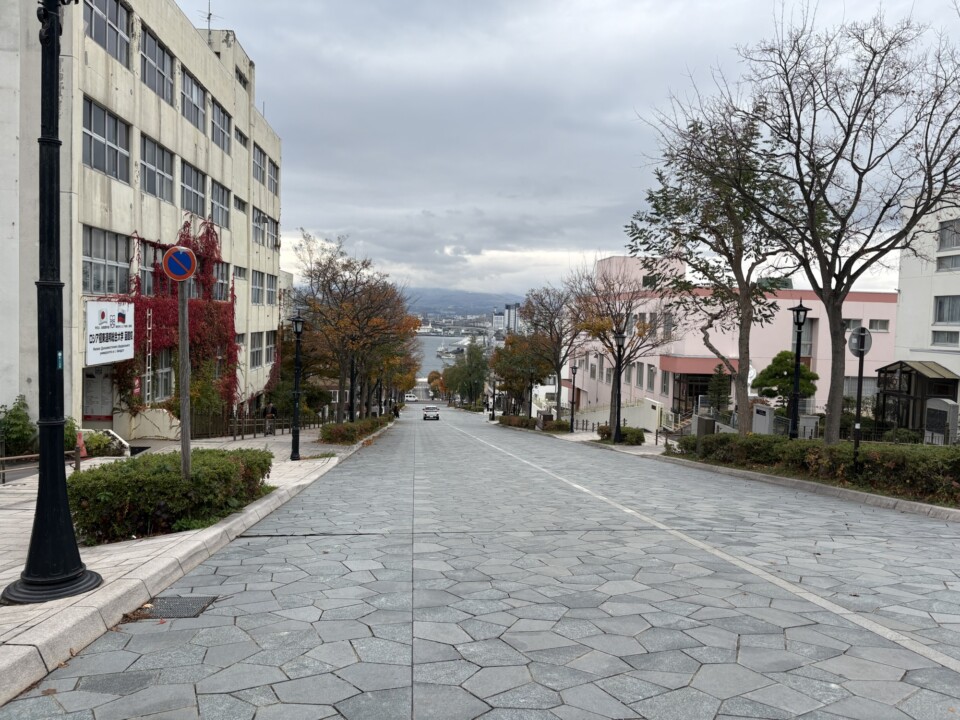
Hachimanzaka falls towards the sea
I understood Hachimanzaka the moment I stood at the top and looked down.
A stone-paved road runs dead straight downhill and terminates in the sea. Trees line both sides, and the harbour and the ships sit exactly at the vanishing point. The composition is so complete that it looks designed.
It was not. It is what happens when you put a road through a city on a slope. The result is a hill that has appeared in a great many films and commercials.
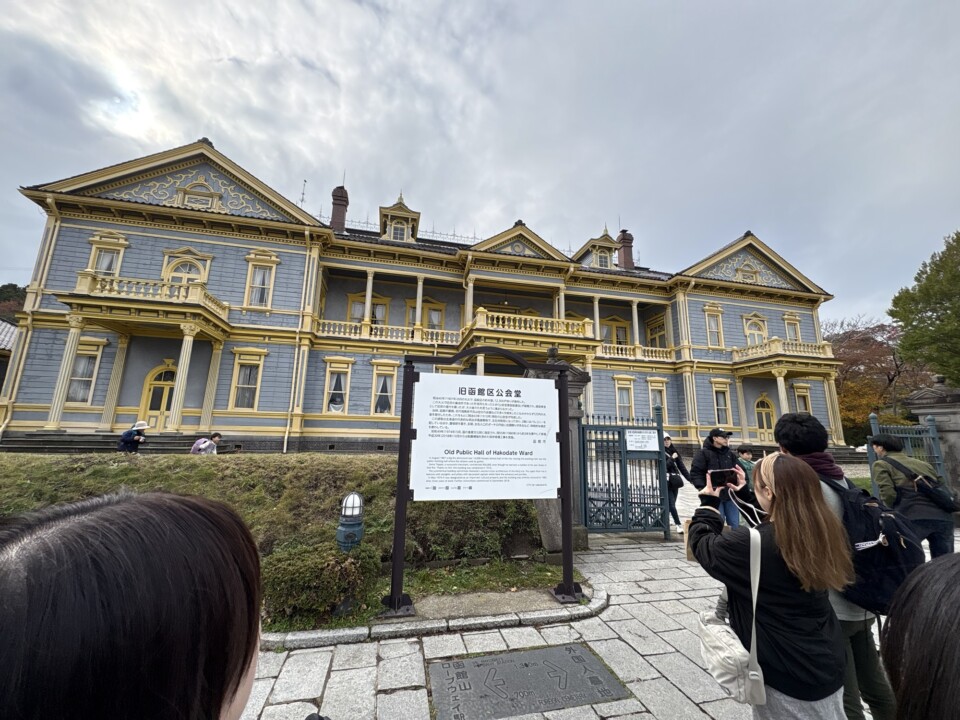
The old public hall dates from 1910
Near the top of the slope stands the Old Public Hall of Hakodate Ward, a two-storey western-style building completed in 1910 and designated an Important Cultural Property.
The exterior is the thing. The entire building is painted blue-grey and yellow, a combination that should not work. That a building of this scale was put up in this colour scheme in late Meiji Japan says plenty about how Hakodate was doing at the time.
There is a broad balcony facing the town and the bay, and the building went through a major restoration between 2018 and April 2021. Which is why something this old looks this vivid.
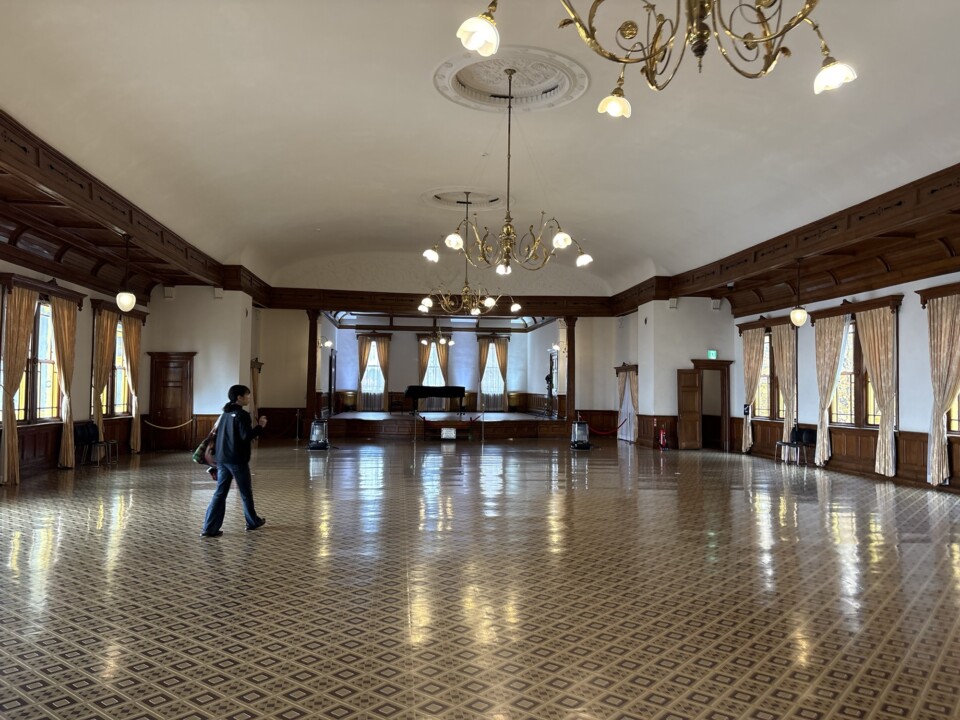
The hall upstairs
Step inside and the air changes.
On the first floor there is a large hall. A chandelier hangs from the ceiling, the floor is parquet, the windows are curtained. Almost no furniture is in the room, so you feel the dimensions directly.
It is a room for imagining what used to happen in it. This was the social space of the period when Hakodate was at its height as a port. Precisely because it is empty, you find yourself reconstructing the density.
Walking a set of film locations
The way we moved through the day ended up close to a pilgrimage.
Hachimanzaka, the public hall, the brick warehouses: all places you half-recognise as backgrounds. Confirming a familiar composition with your own eyes is an entirely legitimate reason to travel.
What is interesting is how different the reality is. The hill is steeper than you pictured and the hall is larger. A frame is always a crop of the thing.
Walk the same streets again after dark
We came back to the same area at night, and I would push this strongly.
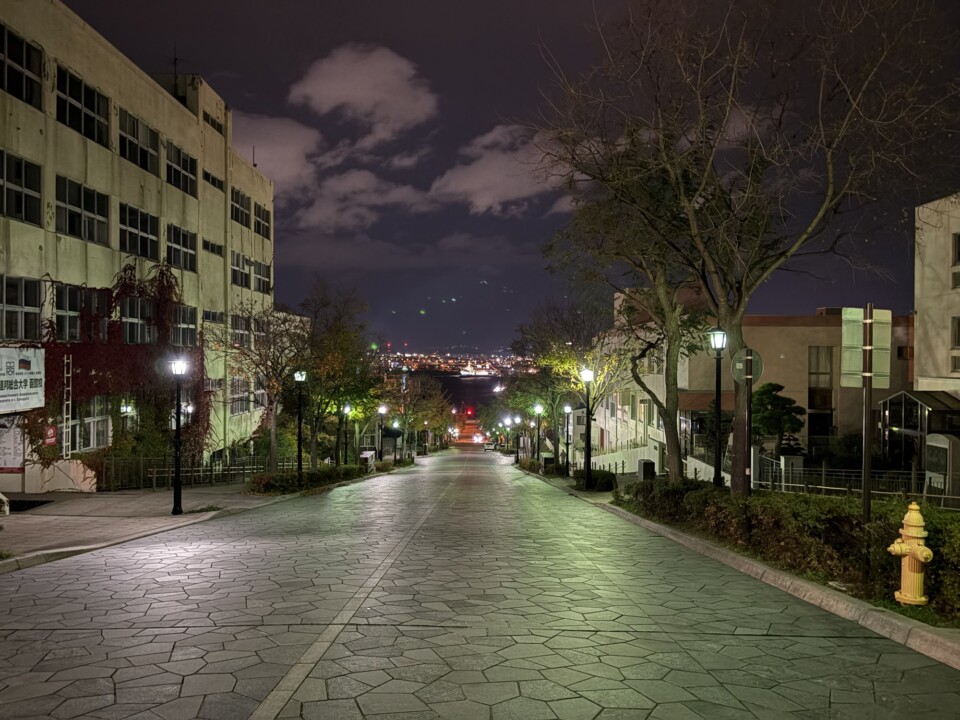
By day Hachimanzaka is about the sea. By night the street lamps light the stone and the slope itself becomes a band of light, with the lights of ships scattered at the far end. It is a completely different place.
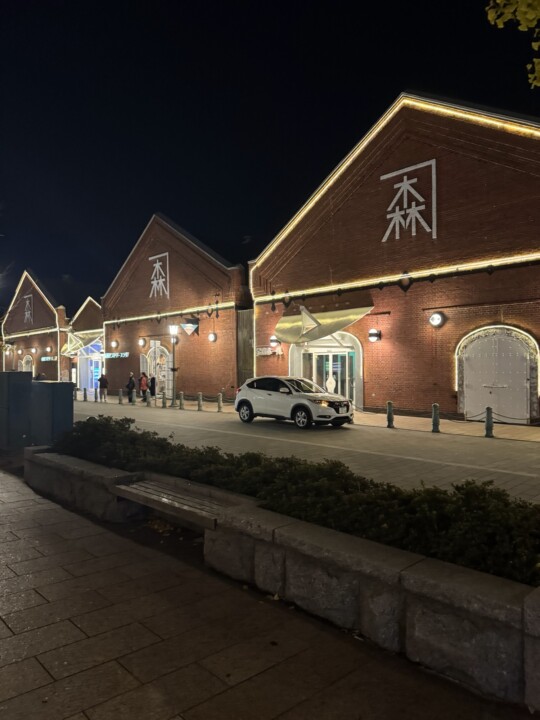
Walk down towards the bay and you reach the Kanemori Red Brick Warehouses, lit up after dark so the brick comes forward in a warm colour. Arriving here after looking down on the city from Mount Hakodate means stepping inside the lights you were just looking at. In that order it is very satisfying.
In short
- One tram line covers Motomachi. Hachimanzaka, the public hall and the warehouses are all on it
- From the stop it is uphill. Motomachi is a slope. Bring shoes for it
- Hachimanzaka ends in the sea. It looks designed; it is geography
- The public hall was completed in 1910. An Important Cultural Property in blue-grey and yellow, with a hall upstairs
- Walk it twice, day and night. They are not the same place
Frequently asked questions
How do I get to Hachimanzaka?
Take the Hakodate tram towards Motomachi and walk up from the stop. Motomachi is on a slope, so comfortable shoes help.
When was the Old Public Hall built?
It was completed in 1910. It is a two-storey western-style building designated an Important Cultural Property, and it was restored between 2018 and April 2021.
Can I go inside the public hall?
You can go inside, and there is a hall on the upper floor. Check current opening and admission with the official information.
Is it worth going at night?
Yes. Street lamps light the stone of Hachimanzaka and it becomes a different scene. The Kanemori Red Brick Warehouses are lit up as well.
Related reading
- Mount Hakodate at night: what to do when the ropeway is closed
- Goryokaku Tower: the star is only visible from above
- Lucky Pierrot: the burger you can only eat in Hakodate
Sources
- Construction year, cultural property designation, restoration period and exterior description of the Old Public Hall of Hakodate Ward: multilingual commentary database, Ministry of Land, Infrastructure, Transport and Tourism
- Everything else is from our visit in November 2026
Related Articles
- Breakfast in Myeongdong: Why the Best One Is Soup, and How to Order It
- The Buddha head in the tree roots at Ayutthaya is smaller than you think
- [Busan] Up the 100th Floor at BUSAN X the SKY: The World’s Highest Starbucks and a Forest of Towers
- QR payment in Thailand did not work for me — and here is exactly why


Comments