Choosing where to stay in Taipei is decided less by the hotel’s star rating than by which station it sits on. Staying at the Sheraton Grand Taipei made that obvious: its position on Shandao Temple station, MRT Bannan line, is what shaped every day of the trip.
- Opened 1981, and it has had three names
- Room and bathroom: a 1981 frame with a 2005 fit-out
- One line all the way to Ximen — this is what the location buys you
- About the Ximending rainbow crossing — ignore the “it’s gone” articles
- The other Taipei — a teahouse in a Japanese-era wooden building
- In short
- Frequently asked questions
Opened 1981, and it has had three names
Old names surface in search results, so clear this up first. The building opened in 1981 as the Lai Lai Shangri-La, became the Lai Lai Sheraton in 1983 when Sheraton took over management, and has been the Sheraton Grand Taipei Hotel since 2002. It was the first Sheraton in Taiwan, and was fully refurbished in 2005.
- Size: 16 floors, 688 rooms
- Address: No. 12, Section 1, Zhongxiao East Road, Zhongzheng District, Taipei
- Nearest station: Shandao Temple, MRT Bannan (blue) line
- Eight restaurants and bars, including The Dragon (Cantonese), Kitchen 12 (buffet), the Antoine Room (steak), Thai, Japanese, and a pizzeria certified by the Naples association
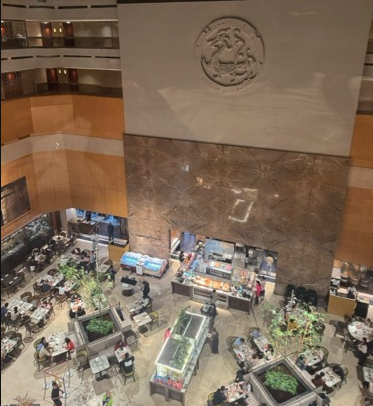
The photo looks down into the atrium from an upper floor. Like a lot of early-1980s grand hotels, the lobby level is cut vertically open, with restaurant seating spread out below. Newer builds rarely do this, and it means the walk back to your room gives you a view of the whole house.
Room and bathroom: a 1981 frame with a 2005 fit-out
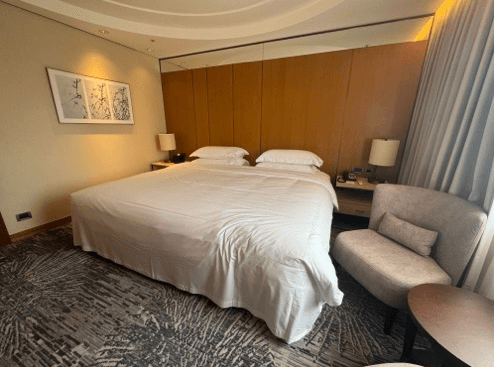
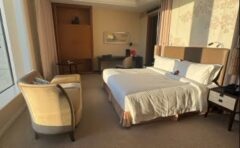
The room is classic in construction — panelled walls, framed pictures, an armchair and a round side table set apart at the far end. There is a place to sit that is not the bed, which is the first thing modern compact city hotels delete, and the thing you notice most on a real stay.
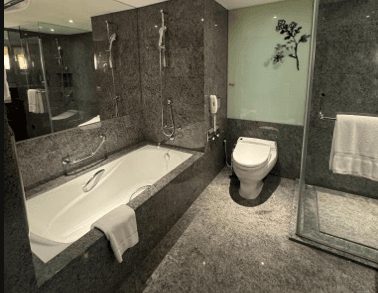
The bathroom is grey stone with the tub and the shower separated. At this price point in Taipei, unit bathrooms and shower-only rooms are common, so this is a real difference if you want to soak. The etched branch motif in the frosted glass places it firmly in that 2005 refit.
One line all the way to Ximen — this is what the location buys you
“Shandao Temple” means nothing to most visitors. Its value is entirely that it is on the Bannan line.
- Shandao Temple → (1 stop) → Taipei Main Station → (1 stop) → Ximen
- No transfers. You can get home on one train however late it gets
- Taipei Main Station is one stop away, so the Taoyuan Airport MRT and the high-speed rail are both a single hop
Most of what visitors come to Taipei for is strung along this line. Zero transfers between your hotel and Ximending pays off precisely on the two days it matters: the first, when you are carrying luggage, and the last, when you are tired.
About the Ximending rainbow crossing — ignore the “it’s gone” articles
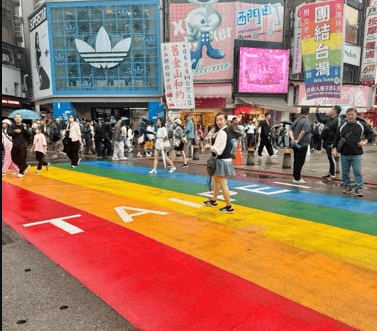
Outside Exit 6 of Ximen station is the rainbow crossing — a 13.2-metre permanent streetscape installed in September 2019, and now the defining photo spot of the district.
Search for it, though, and you need to be careful. On 8 July 2025 it was stripped out for repainting, the paint having weathered badly; the road had to be milled and then left a mandatory fourteen days before repainting, and heavy seasonal rain stretched the schedule further. It came back in mid-August 2025 — but the “the rainbow in Ximending has disappeared” stories from that summer still rank highly. It is there. Do not be put off by old articles.
The other Taipei — a teahouse in a Japanese-era wooden building
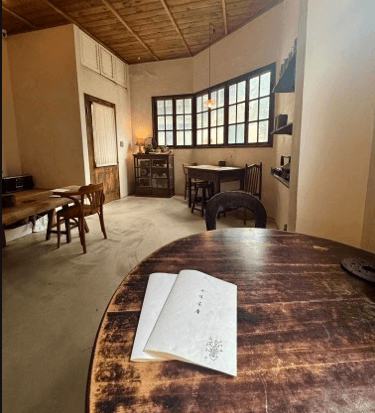
Later the same day: a teahouse occupying a wooden house from the Japanese colonial period. Woven bamboo ceiling, wooden windows divided into small panes, a hard earthen-style floor. Taipei has a number of these converted Japanese-era houses, and the building is as much the exhibit as the tea.
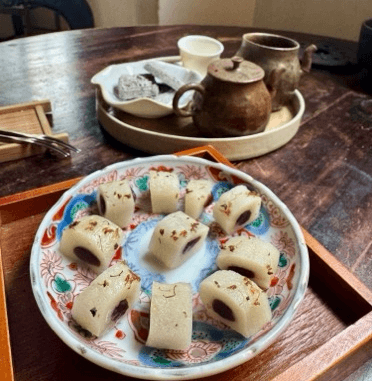
Tea arrives as a set: a purple-clay (zisha) pot, a serving pitcher, and tall narrow aroma cups. The aroma cup is not for drinking — you decant from it into the drinking cup, then bring the empty cup to your nose for the scent left behind. The sweets came arranged in a ring on a painted plate.
Once you have ordered and sat down, an hour or two goes by as a matter of course, which makes late afternoon, after Ximending, the right slot for it. Walk yourself out shopping, then sit and keep topping up the pot. That contrast is what finishes a Taipei day properly.
In short
- The Sheraton Grand Taipei opened in 1981 with 688 rooms, and has changed name three times — watch out for old articles
- The location is really the Bannan line at Shandao Temple: two stops to Ximen, no transfer
- Rooms have somewhere to sit besides the bed, and a tub separate from the shower
- The Ximending rainbow crossing was repainted and restored in August 2025. The “it’s gone” pieces are out of date
- A teahouse is a place to spend time — put it after the shopping, not before
Hotel write-ups tend to become lists of amenities. What actually governed this trip was a single station name. If you are booking Taipei, open the metro map first.
Frequently asked questions
Which station is the hotel on?
Shandao Temple station on the MRT Bannan (blue) line. The address is No. 12, Section 1, Zhongxiao East Road, Zhongzheng District, Taipei. The station name means nothing to most visitors, but its value is entirely that it sits on the Bannan line.
How do you get to Ximending from the hotel?
One line, no transfers: Shandao Temple to Taipei Main Station is one stop, and Taipei Main Station to Ximen is one more. You can get home on a single train however late it gets.
Why do old articles use a different name?
The building opened in 1981 as the Lai Lai Shangri-La, became the Lai Lai Sheraton in 1983 when Sheraton took over management, and has been the Sheraton Grand Taipei Hotel since 2002. It was the first Sheraton in Taiwan and was fully refurbished in 2005.
How big is the hotel, and what is there to eat?
Sixteen floors and 688 rooms, with eight restaurants and bars including The Dragon (Cantonese), Kitchen 12 (buffet), the Antoine Room (steak), Thai, Japanese and a pizzeria certified by the Neapolitan pizza association.
What are the rooms and bathrooms like?
Classic construction — panelled walls, framed pictures, and an armchair with a round side table set apart from the bed, so there is somewhere to sit that is not the bed. The bathroom is grey stone with the tub and the shower enclosure separated, which is a real difference at this price point in Taipei.
Is the Ximending rainbow crossing still there?
Yes. It is a 13.2-metre permanent streetscape outside Exit 6 of Ximen station, installed in September 2019. On 8 July 2025 it was stripped out for repainting and it came back in mid-August of the same year, so the “the rainbow is gone” articles from that summer are simply out of date.
Where should I check rates and availability?
Rates, availability and the opening hours of the hotel restaurants change, so please check the hotel’s official site for the latest information.
Written from my own visit. Rates, hours and details are as they were at the time — please check the official sites for the latest information.
Related Articles
- [Gyeongju] Seokguram Grotto: Lost for Words Before a 1,300-Year-Old Granite Dome
- [Busan] Gamcheon Culture Village, the Machu Picchu of Korea: A Colorful Maze With a Story Underneath
- The St. Regis Bangkok "Spa" Is Actually a Longevity Clinic
- Neungdong Minari in Seongsu: a minari hotpot with the whole surface green
Comments